
Reviewed · BUKCHON HANOK VILLAGE
Seoul Royal Palace,Bukchon Hanok Village & Gwangjang Market Feast
Seoul’s old quarters, royal palace, and street-food stalls all fit into this busy half-day outing. You’ll walk the sloping lanes of Bukchon Hanok Village, watch the colorful guard ceremony at Gwanghwamun Gate, and finish with food at Gwangjang Market.
I like the strong mix of sights and flavors, and I like the low $29 price, which includes transport, a guide, and palace admission. The main caution is the 30-minute ginseng-center stop, which some people may find sales-oriented, and Tuesday’s route changes the palace experience.
In This Review
- Key points at a glance
- A compact introduction to Seoul’s old center
- Bukchon Hanok Village: Seoul’s historic residential lanes
- Gwanghwa Square and Gwanghwamun Gate
- Gyeongbokgung Palace and the Joseon court
- Tuesday’s alternative: Changdeokgung and Insadong
- The 30-minute Korean ginseng-center visit
- Gwangjang Market: the tour’s best finish
- What the guides add to the day
- Is $29 good value for Seoul?
- Who should book this tour?
- Practical details before you reserve
- Should you book it?
- FAQ
- How long does the tour last?
- Where does the tour begin?
- Where does the tour end?
- Is Gyeongbokgung Palace visited every day?
- Is the Guard Changing Ceremony included?
- What happens on Tuesdays?
- Are meals included?
- Is palace admission included?
- Is the tour conducted in English?
Key points at a glance
- Bukchon in one hour: Walk among old hanok homes and narrow lanes in one of Seoul’s most photogenic historic districts.
- Royal ceremony included: On most days, the tour includes Gyeongbokgung Palace and the Guard Changing Ceremony at Gwanghwamun Gate.
- Tuesday route changes: Changdeokgung Palace and Insadong replace Gyeongbokgung and the ceremony on Tuesdays.
- Gwangjang Market finish: Expect time for Korean street food such as bindaetteok and mayak gimbap, though meals are not included.
- Helpful guide style: Guides including Eva, Kelly, Gabby, and Sunny have been praised for clear explanations, good communication, and personal attention.
- Good budget value: The air-conditioned vehicle, English-speaking guide, and admission fee make this an efficient first look at Seoul.
A compact introduction to Seoul’s old center
This 3-hour-30-minute tour gives you a useful first frame for Seoul. You move from a traditional residential quarter to a royal compound, pass Korea’s former Presidential residence, learn about ginseng, and end among food counters at one of the city’s oldest markets.
That variety is the real appeal. You are not spending the entire morning inside one palace or on a bus looking at monuments. The route keeps changing, so the pace feels active. The tradeoff is that each stop receives only a limited amount of time, and the ginseng visit may not appeal to everyone.
The tour begins at Myeongdong Subway Station Exit 8 or Seoul City Hall Subway Station Exit 6, depending on the selected meeting point. An air-conditioned vehicle connects the stops, a useful feature in Seoul’s hot summers or cold winters. The maximum group size is listed as 100, so you should be prepared for a large coach group even though some departures may be much smaller.
More Bukchon and hanok village walks:
- Seoul: Gyeongbok Palace, Bukchon Village, and Gwangjang Tour
★ 4.9 · 2,321 reviews - Seoul City Sightseeing Tour Including Gyeongbokgung Palace, N Seoul Tower, and Namsangol Hanok Village
★ 5.0 · 1,423 reviews - Seoul: Gyeongbok Palace, Bukchon Village, and Gwangjang Tour
★ 5.0 · 1,044 reviews
Bukchon Hanok Village: Seoul’s historic residential lanes
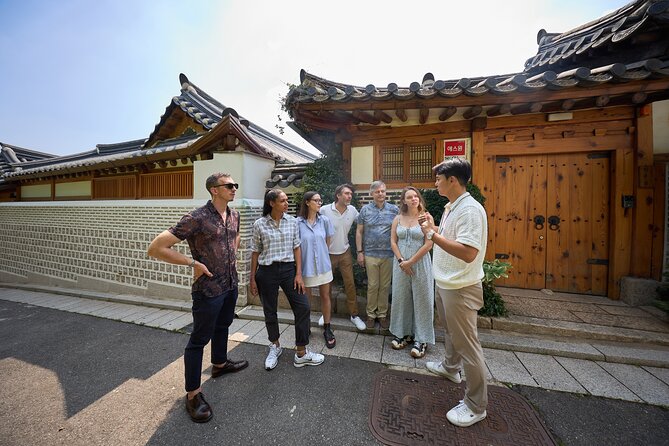
Bukchon is the most atmospheric walking stop. The neighborhood is known for its hanok, traditional Korean homes with tiled roofs, wooden details, and enclosed courtyards. The area dates back roughly 600 years and contains hundreds of these houses.
You will spend about an hour here, walking through winding lanes and looking across the city from elevated streets. The appeal is not one single building. It is the contrast between old homes and modern Seoul, which becomes clear as you move through the neighborhood.
Your guide helps give the lanes a purpose. Without context, Bukchon can look like a collection of attractive walls and roofs. With an explanation of the Joseon-era setting and the neighborhood’s traditional design, the walk becomes easier to understand.
This is also one of the more physical parts of the tour. The streets are sloped, and the old lanes are not designed like a broad museum promenade. Wear comfortable shoes and keep your hands free for short climbs and photo stops.
Bukchon is still a residential area, so you should treat it as someone’s neighborhood rather than a theme park. Keep your voice down near homes and follow the guide’s instructions about where to stop. One hour is enough for a first look, but not enough for every lane, gallery, or shop.
Gwanghwa Square and Gwanghwamun Gate
On days other than Tuesday, the vehicle passes through Gwanghwa Square before reaching the palace. This broad public space sits in central Seoul and offers a good photo opportunity on the way to Gwanghwamun Gate.
Gwanghwamun is the main entrance to Gyeongbokgung Palace. The gate gives the palace visit a strong opening because you first see the royal complex from its grand ceremonial front.
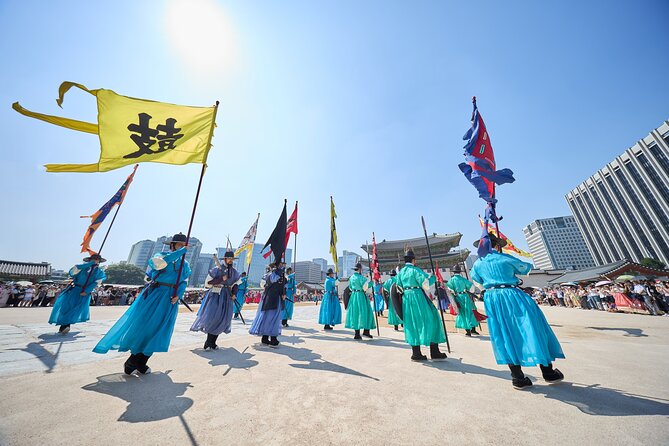
The timing is especially important here. The tour includes the Changing of the Guard ceremony on the regular route. The performance is a reenactment, but the bright uniforms, flags, drums, and formal movements make it a memorable introduction to Korea’s royal past.
The ceremony is not part of the Tuesday schedule. If this is a priority for you, avoid booking Tuesday and confirm the operating schedule when you reserve. The palace route itself also changes that day.
Gyeongbokgung Palace and the Joseon court
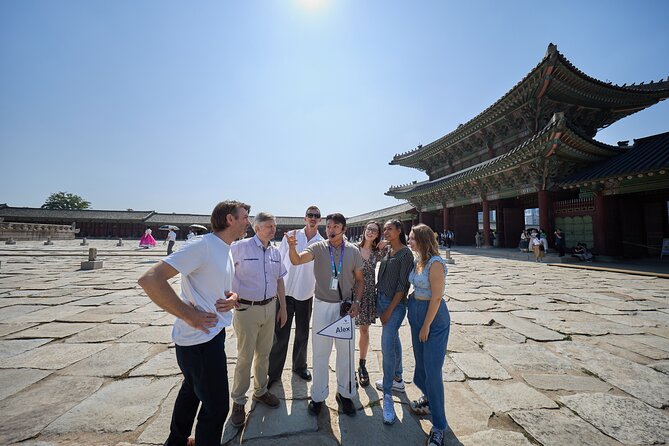
Gyeongbokgung is the largest and grandest palace associated with the Joseon Dynasty. The complex was built more than 600 years ago and includes open courtyards, formal halls, gates, and royal grounds.
You receive about an hour inside the palace. That is enough to see the central areas and hear the main stories, but it is not a slow architectural study. I would treat this as a well-guided introduction rather than a complete palace visit.
The guide makes a major difference here. A palace can become a blur of roofs and courtyards when you are rushing. Guides such as Kelly and Eva have been praised for storytelling and clear explanations, while Gabby has been singled out for making the most of a shorter visit.
The palace is included in the tour price, which improves the value. You do not need to arrange a separate admission ticket for this stop on the regular route.
After the palace, the bus passes the Blue House, Korea’s former Presidential residence. It sits below Bugaksan Mountain and provides a scenic photo view from the route. This is a pass-by stop, not a full interior visit, so keep your camera ready and do not expect extended time on site.
More market food walks:
- Seoul: Night Market Food Tour with Local Guide
★ 4.9 · 943 reviews - Seoul Night Palace & Market Food Tour with Vehicle
★ 5.0 · 275 reviews - Seoul Night Tour (Gwangjang Market, Royal Palace and Naksan Park)
★ 5.0 · 92 reviews - Mangwon Market Food tour By Locals; Cheap Eats to Fancy Feast
★ 5.0 · 38 reviews
Tuesday’s alternative: Changdeokgung and Insadong
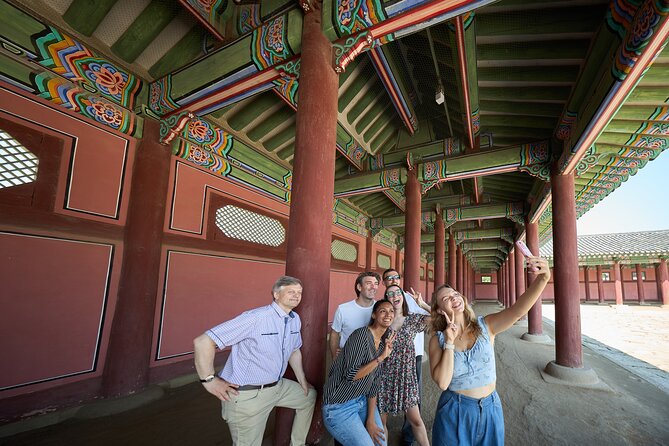
Tuesday is the important exception. Instead of Gyeongbokgung, Gwanghwamun Gate, and the guard ceremony, the tour visits Changdeokgung Palace and Insadong.
Changdeokgung was built in 1405 and is a UNESCO World Heritage site. Its halls and pavilions are arranged with greater attention to the surrounding natural setting than the formal central axis of Gyeongbokgung. The change gives you a different palace experience, not simply a reduced version of the regular route.
Insadong is a traditional arts and shopping district with antique shops, craft stores, tea houses, galleries, and street food. It fits the tour’s cultural theme well, but it is a different kind of stop from Gwanghwamun and the guard ceremony.
The Tuesday substitution should be clear before you book. One disappointing experience described a palace change that was not well understood at the time. The stated schedule does identify Tuesday as the day for Changdeokgung and Insadong, so read the date-specific details carefully and ask the operator if you need certainty.
The 30-minute Korean ginseng-center visit
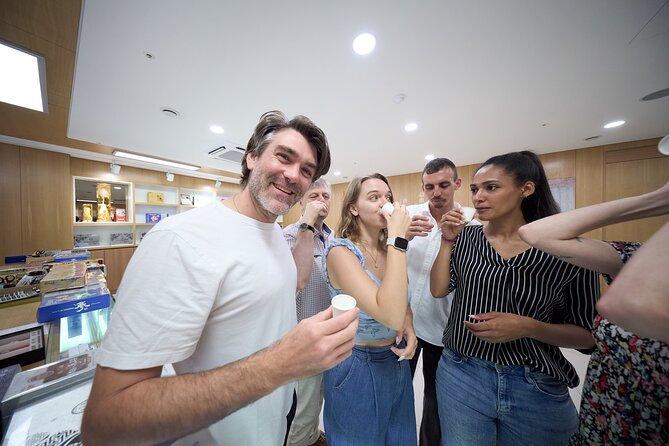
The Cheongha Korean Ginseng Center receives about 30 minutes. You learn about Korean ginseng, known locally as insam, and its traditional health uses.
This stop adds a piece of Korean commercial culture to the day. Ginseng is a famous Korean product, and learning how it is presented can help you recognize it in shops and markets later in your trip.
Still, this is the least universally appealing part of the route. One low-rated account called the visit a tourist trap and strongly warned against buying products there. That criticism is worth taking seriously. You can listen, ask questions, and leave without purchasing anything.
The practical rule is simple: treat the stop as an information visit, not a required shopping opportunity. Do not feel pressured to buy supplements or health products. The tour description does not include a ginseng purchase, and the stop itself is listed as free.
Gwangjang Market: the tour’s best finish
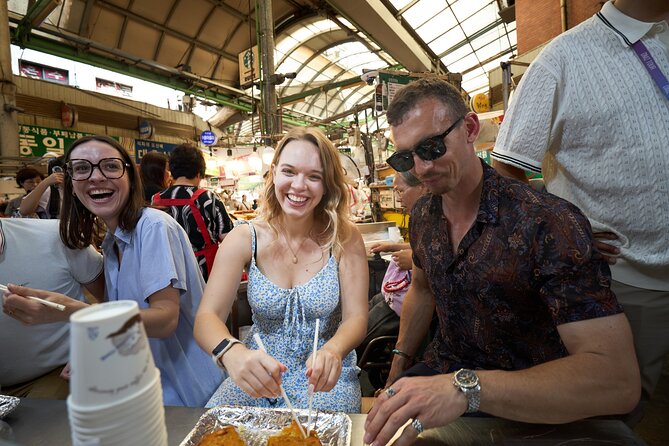
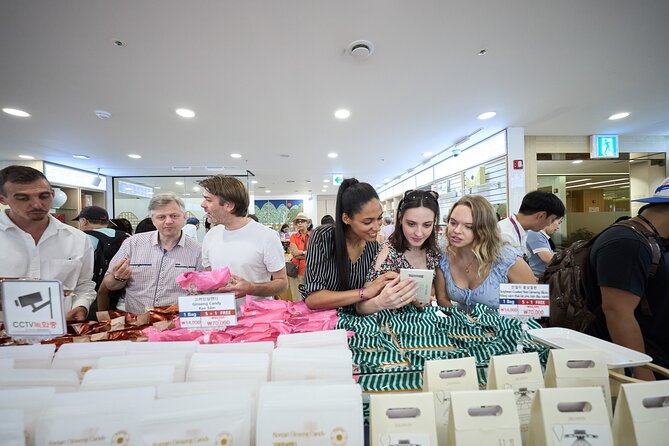
Gwangjang Market is where the tour shifts from royal ceremony to everyday food. Founded in 1905, it is Seoul’s oldest market and a famous place to try prepared Korean dishes at food counters.
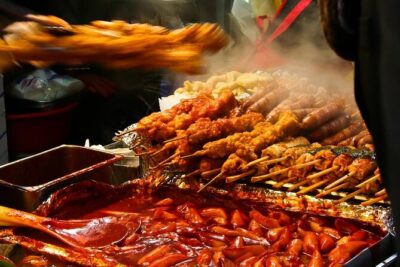
The included market time is about one hour. You may see or taste bindaetteok, a crisp mung-bean pancake, and mayak gimbap, small seaweed rice rolls. Tteokbokki and other Korean snacks are also associated with the food area.
Meals are not included, so carry Korean won or another accepted payment method for anything you want to eat. The market is more useful if you arrive hungry, since the food stop is not a symbolic tasting with a set meal. You choose what interests you and pay separately.
The tour ends at Gwangjang Market, giving you the option to stay longer. You can continue sampling food, shop for souvenirs, or browse local clothing and other goods. There is also a second drop-off option in Myeongdong, a shopping district with beauty products, clothes, street food, and Myeongdong Cathedral.
I like this flexible ending. You are not forced back onto the bus immediately after the market. If you have evening plans near Myeongdong, the alternate drop-off is convenient. If food is your main reason for booking, stay at the market and make the most of the location.
What the guides add to the day
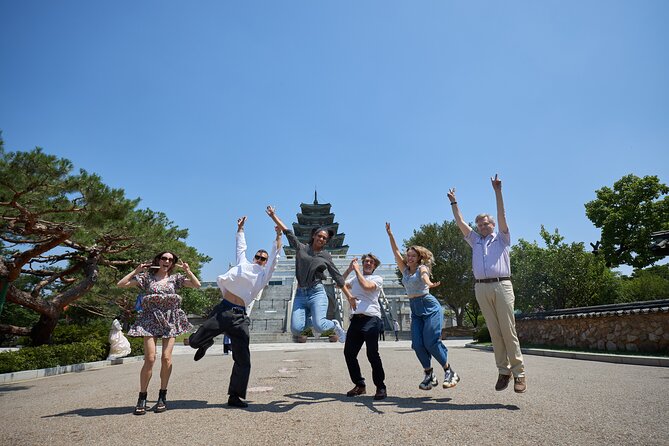
The strongest part of the tour is the guide-led interpretation. Several guides have been praised by name. Eva is described as warm, flexible, and especially good at explaining Korean culture. Kelly receives repeated praise for storytelling, communication, and remembering people in the group.
Gabby is described as friendly and detailed, with a talent for using the available time well. Sunny is praised for looking after a group of six women and even extending their time together. These details suggest a company that can deliver a personal experience when the group is small.
Do not assume every departure will feel private. The listed maximum is 100 people, so the experience can be a full coach tour. A small group may allow more questions and easier movement, while a large group can mean less individual attention at crowded sights.
There was also a small mix-up at the beginning of one outing that the operator resolved. That is a reminder to arrive at the correct subway exit and identify the tour bus and guide before departure. The two meeting points are close to central Seoul, but Exit 8 at Myeongdong and Exit 6 at City Hall are not interchangeable.
Is $29 good value for Seoul?
At $29 per person, this is a strong budget option for a first visit. The price includes an English-speaking guide, an air-conditioned vehicle, and palace admission. You are paying for efficient transport between districts as much as for the commentary.
The price does not include food at Gwangjang Market, drinks, or purchases at the ginseng center. That is reasonable for a market visit because you can choose your own dishes and control your spending.
The value is best if you want a broad introduction in a short window. You would otherwise need to plan the subway connections, palace timing, Bukchon route, and market visit yourself. The tour handles the movement and gives you historical context along the way.
It is less suitable if you prefer long, unhurried visits. Bukchon, the palace, and Gwangjang Market could each fill much more than an hour. You are buying coverage and convenience, not a slow local day.
The 94 percent recommendation rate and 4.7 rating suggest a generally dependable experience, though the small number of published ratings means you should not treat the score as a guarantee. The clearest pattern is that guide quality shapes the day. A strong guide can make the short stops feel full. A poorly explained schedule or unwanted sales stop can weaken the experience.
Who should book this tour?
I would recommend it to a first-time visitor with limited time in Seoul, especially someone staying near Myeongdong or City Hall. It gives you a quick foundation in Korean architecture, royal history, traditional neighborhoods, and food.
It also suits people who prefer guided movement over figuring out Seoul’s central sights alone. Families and mixed-age groups may appreciate the vehicle and compact schedule, though the walking in Bukchon still calls for comfortable shoes.
Food-focused visitors should see the market as the payoff, not a full food tour. You will have time to choose street food, but no meal is included and the guide cannot guarantee that every dish will suit your taste.
I would skip or modify this booking if the ginseng stop sounds irritating, if you want a long palace visit, or if your main goal is the Guard Changing Ceremony and Tuesday is your only available date.
Practical details before you reserve
Confirmation is provided at booking, and the tour is near public transportation. The start and end area is Myeongdong, with the additional start point at Seoul City Hall.
Most people can participate, and the activity uses an air-conditioned vehicle. The group can be as large as 100 people, although smaller departures are possible.
The cancellation policy allows a full refund when you cancel at least 24 hours before the start time. Cancellations or changes made less than 24 hours before departure are not accepted for a refund.
Should you book it?
Book this tour if you want Seoul’s major traditional sights, a palace ceremony, and a market meal opportunity in one affordable morning or afternoon. The guide-led storytelling, included transport, and flexible finish at Gwangjang Market make it particularly useful on a short stay.
Choose a non-Tuesday date for Gyeongbokgung and the Guard Changing Ceremony. If Tuesday is your only option, Changdeokgung and Insadong still provide a worthwhile cultural route, but they are not the same experience.
My main advice is to enjoy the ginseng-center explanation without feeling obliged to shop, arrive at the right subway exit, and save your appetite for Gwangjang Market. For $29, this is a practical sampler of Seoul, provided you are happy with a brisk pace and a few commercial edges.
FAQ
How long does the tour last?
The tour lasts approximately 3 hours and 30 minutes.
Where does the tour begin?
You can meet the tour at Myeongdong Subway Station Exit 8 or Seoul City Hall Subway Station Exit 6, depending on the selected meeting point.
Where does the tour end?
The tour can finish at Gwangjang Market, or you can use the Myeongdong drop-off option.
Is Gyeongbokgung Palace visited every day?
Gyeongbokgung Palace is visited every day except Tuesday. On Tuesdays, the tour visits Changdeokgung Palace instead.
Is the Guard Changing Ceremony included?
The Guard Changing Ceremony at Gwanghwamun Gate is included on the regular route, every day except Tuesday.
What happens on Tuesdays?
The Tuesday route replaces Gyeongbokgung Palace and the Guard Changing Ceremony with Changdeokgung Palace and Insadong.
Are meals included?
No. Food at Gwangjang Market is not included, so you pay separately for dishes and drinks.
Is palace admission included?
Yes. The tour includes the admission fee.
Is the tour conducted in English?
Yes. An English-speaking guide is included.
More Markets in Seoul
- Seoul Street Food Market Tour
★ 5.0 · 1,226 reviews - Local Home Korean Cooking Class & Market Adventure in Seoul
★ 5.0 · 1,024 reviews - Downtown Seoul Guided Food & Market Tour with 8+ Local Tastings
★ 5.0 · 580 reviews - Seoul: Korean Cooking Class at a Local Home and Market Tour
★ 5.0 · 348 reviews
More Palace Tours in Seoul
- Best Seoul City Tour (Gyeongbokgung Palace,Insadong,Namsan Tower)
★ 5.0 · 1,647 reviews - Small-Group Royal Palace and Seoul City Tour (hotel pick-up)
★ 5.0 · 1,474 reviews - Seoul Highlights: Gyeongbok Palace, Insadong & N Seoul Tower
★ 4.7 · 726 reviews - Seoul: Hanbok Rental with Gyeongbokgung Palace Entry
★ 4.6 · 611 reviews
Just added around Seoul
- Incheon Airport Private Transfer between Seoul City★ 4.0 · 4 reviews
- Seoul’s Stars: Open Mic with Local & International Talent★ 4.8 · 4 reviews
- Samaksan Cable Car and Nami Island Day Escape with Railbike★ 4.0 · 4 reviews
- DMZ 2nd Tunnel and Cheorwon Peace Observatory with Admission★ 5.0 · 4 reviews
- Nami & Maple Road & Theatre des Lumieres Day Tour from Seoul★ 4.8 · 4 reviews
- Hire Photographer, Professional Photo Shoot – Seoul★ 5.0 · 4 reviews
- [KoreaByLocal] Authentic Seoul Night Walk and Chicken & Beer★ 5.0 · 4 reviews
- Play Gayageum in Hanbok Cultural Experience in Bukchon★ 5.0 · 4 reviews
Bukchon Hanok Village, compared.
Gyeongbok Palace, Bukchon Village, and Gwangjang Tour
Read our review →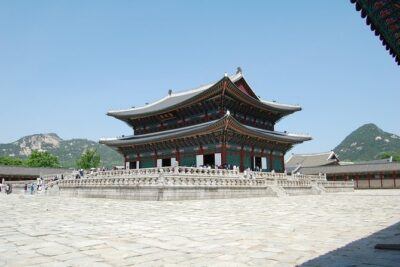
Seoul City Sightseeing Tour Including Gyeongbokgung Palace, N Seoul Tower, and Namsangol Hanok Village
Read our review →Gyeongbok Palace, Bukchon Village, and Gwangjang Tour
Read our review →
Gyeongbok Palace and Bukchon Hanok Walking Tour
Read our review →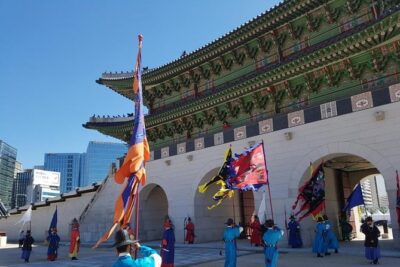
Best Walking Tour to Gyeongbok Palace Bukchon Hanok Village
Read our review →Experience Korean Cooking in Modern Hanok Kitchen
Read our review →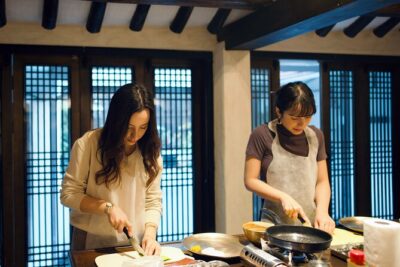
Royal Seoul Cooking Class in a 100-Year-Old Hanok
Read our review →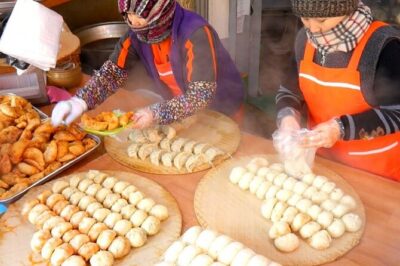
Afternoon Seoul: Hanok Vibes, Netflix Street Food & N Seoul Tower
Read our review →Browse the lists this tour appears in