
Reviewed · GYEONGBOKGUNG PALACE
Seoul: Gyeongbok Palace, Bukchon Village, and Gwangjang Tour
Gyeongbokgung Palace, traditional hanok lanes, a mountain lookout, and one of Seoul’s best food markets make this a clever first look at the city. For about $32 per person, you cover a lot of ground without wrestling with Seoul’s traffic and subway map on your first day.
I like the fully narrated palace visit, especially the chance to watch the Royal Guard Changing Ceremony. I also like the finish at Gwangjang Market, where you can trade polished sightseeing for mung bean pancakes, mayak gimbap, and other Korean snacks.
The catch is the pace. This is a sightseeing sampler, not a slow cultural walk. The ginseng museum includes shopping, and the exact route changes by day and booking option, so read the details carefully before you pay.
In This Review
- Key points to know before booking
- Why this tour works as a first day in Seoul
- Gyeongbokgung Palace and the royal guard ceremony
- Tuesday changes the palace plan
- Bukchon Hanok Village, traditional Seoul with a practical warning
- Bugak Skyway and Bugak Palgakjeong
- The Korean Ginseng Museum and the shopping stop
- Gwangjang Market, the best place to finish hungry
- The full-day route adds serious historical context
- Guides, transport, and the pace of the day
- Who gets the best value for $32
- Small details that make the day easier
- Should you book this Seoul tour?
- FAQ
- How much does the Seoul tour cost?
- How long does the tour last?
- Is hotel pickup included?
- What language is the tour conducted in?
- Which palace does the standard tour visit?
- Does the Tuesday tour visit Gyeongbokgung Palace?
- Is the N Seoul Tower observatory included?
- Is food included?
- Can I rent a hanbok during the tour?
- Is the tour suitable for wheelchair users?
Key points to know before booking
- The Royal Guard Changing Ceremony anchors the palace visit, but the palace varies on Tuesday.
- Bukchon Hanok Village is a living neighborhood, with traditional homes now used for cultural centers, guesthouses, and restaurants.
- Bugak Palgakjeong gives you a high view of Seoul without requiring a mountain hike.
- Gwangjang Market is the practical finale, with food stalls and inexpensive shopping.
- The $32 price is strong value for transport, a guide, and entrance fees on the shorter option.
- Full-day and private versions are available, but the longer route adds lunch at your own expense and several city sights.
Why this tour works as a first day in Seoul
Seoul can feel like several cities at once. Grand Joseon-era gates sit near modern office towers, narrow traditional lanes open onto steep hills, and a street-food market can be as useful for understanding daily life as a museum.
This tour links those contrasts in one outing. You begin with royal architecture, move through a residential hanok district, rise to a mountain road for city views, stop for Korean ginseng, and end with food and shopping at Gwangjang Market.
That range is the main reason I would consider booking it early in a Seoul visit. You get enough orientation to decide where you want to return later. The guide also fills in context that is easy to miss when you explore alone, from palace customs to modern Korean culture, K-pop, and Korean dramas.
The shorter shared tour lasts roughly four hours, though the available options range from four to nine hours. Transport is by air-conditioned minivan or coach. Pickup from central Seoul is included only with selected options, and private tours have their own pickup arrangement.
More Gyeongbokgung visits:
- Best Seoul City Tour (Gyeongbokgung Palace,Insadong,Namsan Tower)
★ 5.0 · 1,647 reviews - Seoul City Sightseeing Tour Including Gyeongbokgung Palace, N Seoul Tower, and Namsangol Hanok Village
★ 5.0 · 1,423 reviews - Seoul: Gyeongbok Palace, Bukchon Village, and Gwangjang Tour
★ 5.0 · 1,044 reviews
Gyeongbokgung Palace and the royal guard ceremony
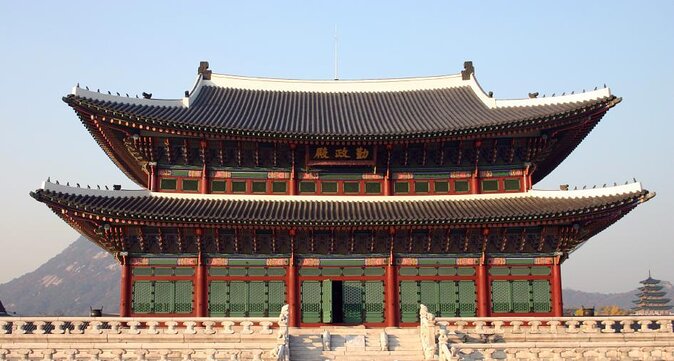
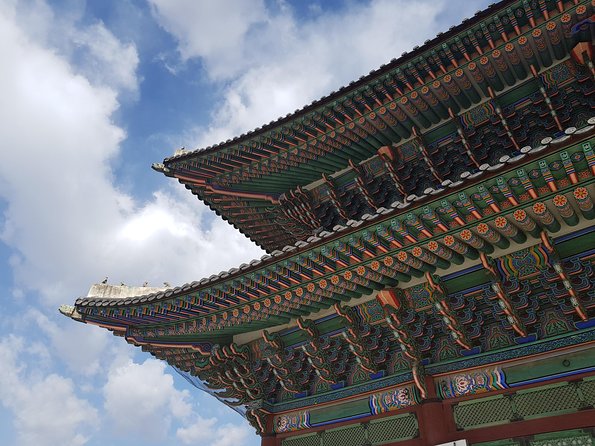
Gyeongbokgung is the grand opening act. It is the largest and often considered the most beautiful of Seoul’s five major palaces, with broad courtyards, formal gates, and traditional buildings that make the scale of the old royal complex easy to appreciate.
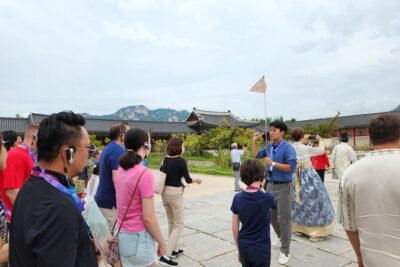
The guided visit lasts about an hour. That is enough time to see the main areas and understand why the palace matters, but not enough for every corner. I like this arrangement for a first visit because a guide can point out what deserves your attention instead of leaving you to wander through a large complex without a plan.
The Royal Guard Changing Ceremony adds movement and color to the visit. It is a distinctive palace tradition and a strong photo opportunity. Your guide should help explain what you are watching, which makes the ceremony more than a quick stop for pictures.
Arrive at the correct starting point on time. Joining at Gyeongbokgung after the tour has begun is not permitted, and contacting the guide once the tour is underway is also not allowed. This matters because the group uses fixed transport between stops.
The palace grounds involve walking, and comfortable shoes are essential. Hanbok rental is not offered as part of this activity, so arrange that separately if wearing traditional dress is important to you.
Tuesday changes the palace plan
Tuesday is the odd day in this schedule. Instead of the usual Gyeongbokgung and Bugak Skyway route, the Tuesday version visits N Seoul Tower, with the observatory excluded, Bukchon Hanok Village, Deoksugung Palace, the Royal Guard Changing Ceremony, the Korean Ginseng Museum, and Gwangjang Market.
That version gives you a different view of Seoul. N Seoul Tower provides a familiar city landmark, while Deoksugung offers another royal setting. Since the observatory ticket is not included, do not assume you will go to the top.
The Tuesday route also means the exact palace experience differs from the standard tour. If Gyeongbokgung is your main reason for booking, check the day before selecting your date. If you want a broader mix of city sights, Tuesday may suit you well.
Bukchon Hanok Village, traditional Seoul with a practical warning
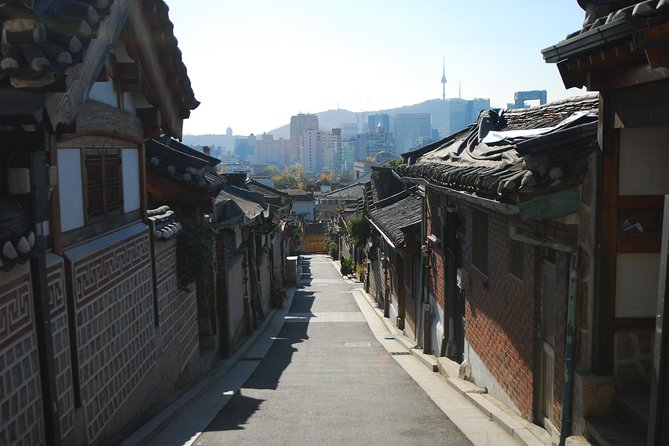
Bukchon Hanok Village translates roughly as northern village. Its traditional Korean houses are not simply preserved facades. Many now serve as cultural centers, guesthouses, and restaurants, so the area connects historic design with present-day Seoul.
The guided visit takes about 30 minutes. That is short, but useful. Bukchon is best approached with some awareness that it is a real neighborhood, not just an open-air museum. Keep your voice down, follow local signs, and avoid treating private doorways as photo props.
This is one of the tour’s most photogenic stops. The dark-tiled roofs, narrow lanes, and hillside views give you a different visual experience from the palace courtyards. Your guide may also help with photos, a small kindness that several guests appreciated, especially for solo visitors.
Bukchon can be closed under certain circumstances. If it is unavailable, the tour substitutes Namsangol Hanok Village. The replacement keeps the traditional architecture theme but is not the same place, so check the current route if this stop is especially important to you.
More Bukchon and hanok village walks:
- Seoul: Gyeongbok Palace and Bukchon Hanok Walking Tour
★ 4.8 · 157 reviews - Best Walking Tour to Gyeongbok Palace Bukchon Hanok Village
★ 5.0 · 138 reviews - Experience Korean Cooking in Modern Hanok Kitchen
★ 5.0 · 118 reviews - Royal Seoul Cooking Class in a 100-Year-Old Hanok
★ 5.0 · 81 reviews
Bugak Skyway and Bugak Palgakjeong
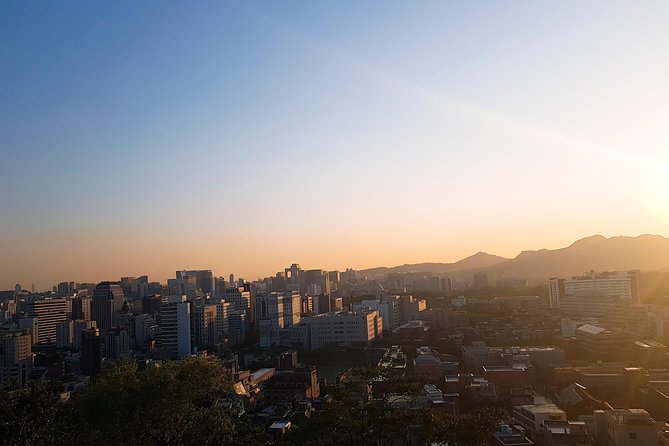
After the denser historic districts, the tour heads toward Bugak Skyway. The road leads to Bugak Palgakjeong, also called Bugak Pavilion, on the slopes of Bugaksan Mountain.
The pavilion stop itself is listed at about 10 minutes, with a longer 30-minute guided visit for Bugak Skyway. This is a scenic pause rather than a hiking outing. You can look across Seoul from above, take photographs, and enjoy a quieter stretch between the palace and market.
I like this inclusion because city tours often pile one urban stop on top of another. Bugak gives your eyes a break and helps you understand Seoul’s setting among hills. The view can also make the city’s size easier to grasp than a street-level walk alone.
Your experience will depend on weather and visibility. The tour operates rain or shine, and the lookout is outdoors. Bring suitable clothing and shoes, particularly in winter. One visitor specifically appreciated the hand warmers provided by guide Sophie on a very cold day, but you should still dress for the conditions rather than count on that.
The Korean Ginseng Museum and the shopping stop
The Korean Ginseng Museum, identified as Cheongha Korea Ginseng in the tour details, is a 30-minute shopping visit. You learn about Korean ginseng and its long role in East Asian medicine before browsing ginseng products.
Korean ginseng has been treated as a powerful all-purpose remedy in traditional culture, and the stop explains why it remains an important Korean product. The focus is commercial as well as educational. You may find a wide range of ginseng products, but this is not a quiet museum visit in the usual sense.
That distinction matters. Some people will enjoy learning about a well-known Korean export and having a chance to buy a gift. Others may prefer more time at the palace or market. I would treat the stop as a shopping presentation built into the route, not as a major museum visit.
Personal expenses are not included. If you buy anything, that cost is yours, and you are not required to include shopping in your overall Seoul budget.
Gwangjang Market, the best place to finish hungry
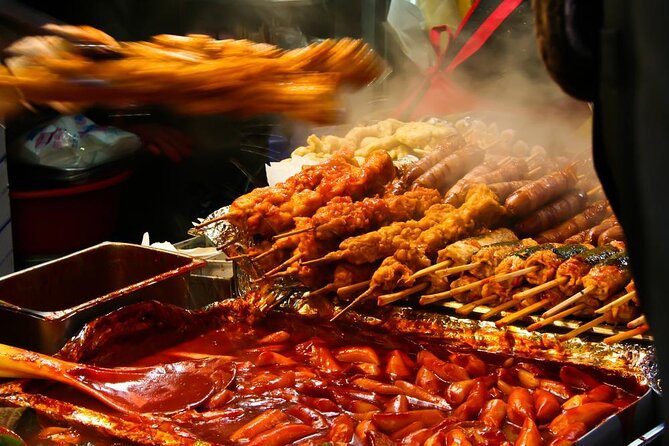
The standard route ends at Gwangjang Market, Seoul’s first market, and this is where the tour shifts from formal sightseeing to everyday food culture.
The market is known for inexpensive goods rather than major international brands. The selection includes high-quality items at low prices, but bargain shopping is only part of the appeal. Food is the reason many people will want extra time here.
Look for bindaetteok, savory mung bean pancakes, and mayak gimbap, small seaweed rice rolls with a famously addictive reputation. The tour does not include food or drinks, so bring money for lunch or snacks. You can also use the market as a simple starting point for the rest of your evening.
The shorter tour drops you at Gwangjang Market rather than returning you to your hotel. That is useful if you want to continue eating and shopping, but less convenient if you expected a hotel return. Drop-off choices include Gwangjang Market and Myeongdong Cathedral, depending on the option selected.
The full-day route adds serious historical context
The full-day version keeps the main morning route, then allows time for lunch at your own expense before continuing to the War Memorial of Korea, Jogye Temple, and Tapgol Park. It finishes at Myeongdong Cathedral.
The War Memorial visit focuses mainly on the third-floor United Nations Memorial Cemetery section. This adds modern Korean and international history to a day otherwise centered on royal Seoul and traditional neighborhoods.
Jogye Temple gives you a Buddhist site in the city center, while Tapgol Park adds another historical stop. Myeongdong Cathedral provides a final landmark before the tour ends. This longer route is better for you if history is a major reason for visiting Seoul and you have a full day available.
The tradeoff is energy. Nine hours of sightseeing, walking, vehicle transfers, and explanations can feel long, especially in cold weather or rain. The full-day route also leaves lunch to you, so plan to pay separately at the market or nearby.
Guides, transport, and the pace of the day
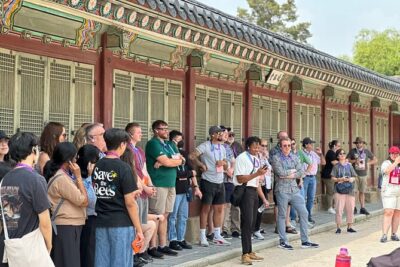
The guide language is English. The people leading recent tours include Sophie, Sunny, Grace, Chloe, Shin, Henry, Winnie, and others. The strongest pattern in the feedback is not one particular guide, but the care taken to explain history clearly, answer questions, include solo visitors, and keep different age groups engaged.
Sophie is noted for warmth, cultural detail, and practical help in cold weather. Sunny is praised for humor and for making sure everyone is included. Chloe is described as lively and good at adjusting her jokes to the group, while Shin receives praise for his palace and Korean history explanations. Grace is often singled out for clear stories and patient answers.
Your actual guide will depend on the date and assignment. Still, the tour appears to place real importance on the human side of the experience. That matters in a shared group, where a poor guide can make a busy schedule feel tiring.
Transport is air-conditioned and receives a very strong score from 95 percent of people who rated it. The vehicle helps connect stops that would take more effort by subway, especially the Bugak route. Traffic can still affect timing, and the schedule is not designed for long independent visits at each location.
Pickup is optional and depends on the booking. Selected hotel pickup areas include Gangnam, Myeongdong, Gwanghwamun, Itaewon, and Dongdaemun, generally between 7:20 and 8:40 in the morning. If pickup is not included, use the stated meeting point and subway directions. Do not simply go to Gyeongbokgung and try to join the group there.
Who gets the best value for $32
At $32, the shorter shared tour is good value if you want transport, an English-speaking guide, entrance fees, and several major Seoul sights in one compact outing. Buying palace admission and arranging transport independently may cost less in cash, but you would lose the narration and the efficient connection between districts.
The price is especially sensible for a first-time visitor, a solo visitor who wants company, or anyone with only a short stay. It also works well for families, since several guides are praised for keeping children engaged and maintaining a comfortable pace.
A private group is available if you want more control over the day. That option may be better for families, friends, or anyone who dislikes moving on a shared schedule. The provided details do not state the private-group price, so compare it before booking.
This is not a wheelchair-friendly activity. It also involves walking, outdoor viewing areas, and fixed group timing. If you want to linger over palace architecture, rent a hanbok, or eat a long lunch at Gwangjang Market, plan a separate visit.
Small details that make the day easier
Wear comfortable shoes. You will walk through palace grounds, village lanes, market areas, and lookout spaces, even though the vehicle handles the longer connections.
Bring weather protection. The tour runs in rain or shine, and the Bugak stop is outdoors. Winter visitors should bring warm layers, gloves, and something for wind.
Keep the evening open if you choose the shorter version. Ending at Gwangjang Market or Myeongdong Cathedral gives you freedom, but it also means there is no standard hotel drop-off included.
The activity allows free cancellation up to 24 hours ahead for a full refund, and you can reserve now and pay later. Those terms are useful if your Seoul schedule is still shifting.
Should you book this Seoul tour?
Book it if you want a well-priced introduction to Seoul that mixes royal buildings, traditional streets, a hilltop view, Korean shopping, and market food. It is particularly useful on your first day, when a guide can help you get your bearings and show you which parts of the city deserve a return visit.
Choose the full-day option if you want the War Memorial, Jogye Temple, Tapgol Park, and Myeongdong Cathedral added to the core route. Choose the Tuesday version only after checking that N Seoul Tower and Deoksugung Palace fit your priorities.
Skip it if you prefer slow, independent exploration or dislike shopping stops. For most visitors with limited time, though, the $32 half-day route delivers a lot: palace ceremony, history, photos, mountain views, and a delicious excuse to finish the afternoon at Gwangjang Market.
FAQ
How much does the Seoul tour cost?
The listed price is $32 per person. Private and full-day options may have different prices, so check the selected option before booking.
How long does the tour last?
Available options range from about four to nine hours. The shorter shared route is a half-day experience, while the full-day version includes additional historical and cultural stops.
Is hotel pickup included?
Pickup is included only with selected options. The pickup service is offered for private tours or qualifying bookings from central Seoul areas such as Gangnam, Myeongdong, Gwanghwamun, Itaewon, and Dongdaemun.
What language is the tour conducted in?
The live tour guide speaks English.
Which palace does the standard tour visit?
The standard route visits Gyeongbokgung Palace and includes the Royal Guard Changing Ceremony.
Does the Tuesday tour visit Gyeongbokgung Palace?
The Tuesday route is different. It visits N Seoul Tower, without the observatory, and Deoksugung Palace with the Royal Guard Changing Ceremony instead.
Is the N Seoul Tower observatory included?
No. The Tuesday option includes N Seoul Tower, but the observatory is not included.
Is food included?
No. Food and drinks are not included. The full-day route includes lunch time, but lunch is at your own expense.
Can I rent a hanbok during the tour?
No. Hanbok rental is not offered as part of this activity.
Is the tour suitable for wheelchair users?
No. The tour is not suitable for wheelchair users. Comfortable walking shoes are recommended for all participants.
More Palace Tours in Seoul
- Small-Group Royal Palace and Seoul City Tour (hotel pick-up)
★ 5.0 · 1,474 reviews - Seoul Highlights: Gyeongbok Palace, Insadong & N Seoul Tower
★ 4.7 · 726 reviews - Seoul: Hanbok Rental with Gyeongbokgung Palace Entry
★ 4.6 · 611 reviews - Seoul City Half Day Tour-Gyeongbok Palace Guard Changing Ceremony
★ 4.5 · 357 reviews
More Market Food Tours in Seoul
- Seoul: Night Market Food Tour with Local Guide
★ 4.9 · 943 reviews - Seoul Night Palace & Market Food Tour with Vehicle
★ 5.0 · 275 reviews - Seoul Night Tour (Gwangjang Market, Royal Palace and Naksan Park)
★ 5.0 · 92 reviews - Mangwon Market Food tour By Locals; Cheap Eats to Fancy Feast
★ 5.0 · 38 reviews
Just added around Seoul
- Incheon Airport Private Transfer between Seoul City★ 4.0 · 4 reviews
- Seoul’s Stars: Open Mic with Local & International Talent★ 4.8 · 4 reviews
- Samaksan Cable Car and Nami Island Day Escape with Railbike★ 4.0 · 4 reviews
- DMZ 2nd Tunnel and Cheorwon Peace Observatory with Admission★ 5.0 · 4 reviews
- Nami & Maple Road & Theatre des Lumieres Day Tour from Seoul★ 4.8 · 4 reviews
- Hire Photographer, Professional Photo Shoot – Seoul★ 5.0 · 4 reviews
- [KoreaByLocal] Authentic Seoul Night Walk and Chicken & Beer★ 5.0 · 4 reviews
- Play Gayageum in Hanbok Cultural Experience in Bukchon★ 5.0 · 4 reviews
Gyeongbokgung Palace, compared.
Best Seoul City Tour (Gyeongbokgung Palace,Insadong,Namsan Tower)
Read our review →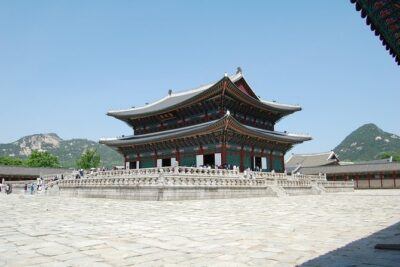
Seoul City Sightseeing Tour Including Gyeongbokgung Palace, N Seoul Tower, and Namsangol Hanok Village
Read our review →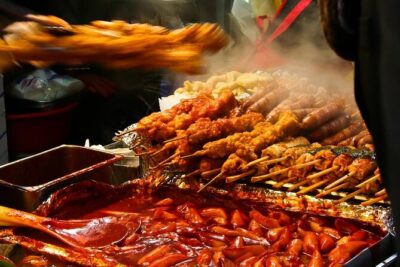
Gyeongbok Palace, Bukchon Village, and Gwangjang Tour
Read our review →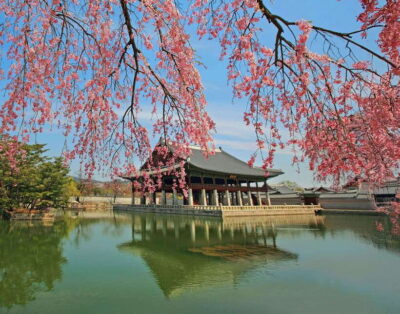
Seoul Highlights: Gyeongbok Palace, Insadong & N Seoul Tower
Read our review →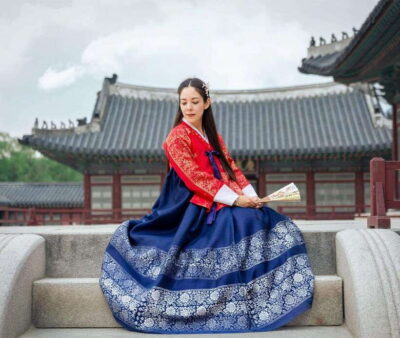
Seoul City Half Day Tour-Gyeongbok Palace Guard Changing Ceremony
Read our review →
Hanbok Photoshoot and History Tour at Gyeongbokgung Palace
Read our review →Browse the lists this tour appears in