
Reviewed · DMZ & JSA TOURS
DMZ Tour + The War Memorial of Korea Museum
The most striking part of this day is the contrast between ordinary Seoul and the heavily guarded border only about 90 minutes away. At Imjingak Pyeonghwa Nuri Park, you see war memorials and a damaged steam locomotive. At the DMZ, the mood shifts from public remembrance to active military control. The Third Tunnel makes that danger feel physical: it is steep, narrow, and not an easy stroll.
I like two things in particular. First, the tour links the border sites with the War Memorial of Korea, giving you both the place where the conflict remains visible and the historical background needed to understand it. Second, the guides appear to take their work seriously. Bill, Kane, Ann Jung, Jae Seo, and others are praised for clear English, good timing, personal communication, and patient help.
The main drawback is the rigid schedule and early start. You have little control if the military changes access, weather delays the tour, or the observatory is closed. The border also brings rules about passports, photography, and movement, so this is not a relaxed sightseeing day.
In This Review
- Key points before you book
- Why this DMZ day works better than a border visit alone
- Imjingak Pyeonghwa Nuri Park and the Bridge of Freedom
- The DMZ exhibition hall and its strict rules
- Dora Observatory and the view toward North Korea
- Walking the Third Infiltration Tunnel
- The War Memorial of Korea in Seoul
- Guides, group size, and the pace of the day
- Timing, transport, lunch, and what to carry
- Cancellations and border uncertainty
- Is this DMZ and War Memorial tour worth booking?
- FAQ
- How long does the tour last?
- Where does the tour begin?
- Where does the tour end?
- Do I need to bring my passport?
- Is lunch included?
- How difficult is the Third Tunnel?
- Can I take photographs at the DMZ?
- What happens if bad weather closes the DMZ?
Key points before you book
- The Third Tunnel is physically demanding: Expect a steep, narrow route and wear comfortable shoes.
- Your passport is required: You will not be allowed into the DMZ without it.
- The War Memorial adds needed context: The museum helps make sense of what you see at the border.
- Guiding is a major strength: Guides including Bill, Kane, Ann Jung, Jae Seo, and Kevin are praised for history, organization, and care.
- The tour runs about eight to nine hours: Pickup begins at 7:00 am from Myeong-dong Station and ends in the Myeong-dong area.
- The border schedule can change: Military concerns and bad weather can cause delays, cancellations, or a different visit plan.
Why this DMZ day works better than a border visit alone
A DMZ visit can be hard to understand if you see only fences, guard posts, and a distant view of North Korea. This tour builds a useful sequence. You begin with the emotional reminders of the Korean War at Imjingak, move into the official DMZ exhibits, walk through the Third Infiltration Tunnel, look north from Dora Observatory, then finish at a large museum in Seoul.
That order gives you a strong sense of place first, followed by a chance to organize what you have seen. The War Memorial comes late, so you may wish you had its background before reaching the border. Still, the museum works well as a final stop because it gives names, dates, military context, and a wider view of Korea’s wartime experience.
At $65 per person, the value is not just the admission tickets. You are also paying for air-conditioned transportation, parking fees, a professional guide, and the convenience of handling several sites in one long day. Getting to the border on your own would require more planning, and access rules make a guided visit much simpler.
The price is fair for a full-day excursion, especially if you want transportation and explanations rather than a quick photo stop. It is less appealing if you prefer to set your own pace or want a quiet museum day. The maximum group size is 40, though some departures have been much smaller and used a van.
More ways to reach the DMZ:
- Best DMZ Tour Korea from Seoul (Red Suspension Bridge Optional)
★ 5.0 · 41,422 reviews - DMZ Tour: 3rd Tunnel, Option(Suspension Bridge, Boat) from Seoul
★ 5.0 · 21,373 reviews - DMZ tour south Korea from Seoul (NK experience hall, defector)
★ 5.0 · 20,599 reviews
Imjingak Pyeonghwa Nuri Park and the Bridge of Freedom
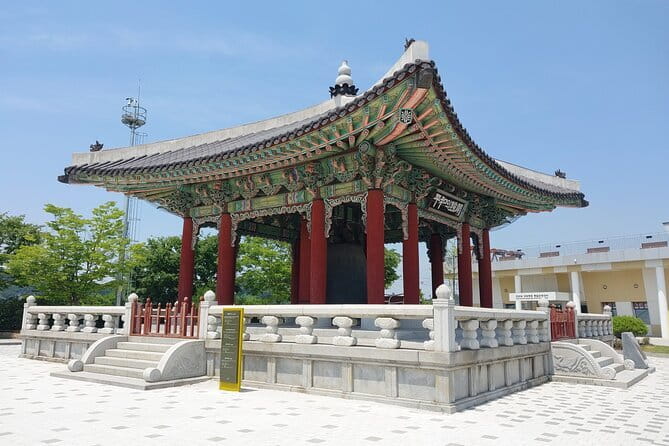
The first stop is Imjingak Pyeonghwa Nuri Park, about an hour and a half from Seoul. This is a public memorial area focused on the Korean War and the divided peninsula. It is also where the border experience becomes more than a military sightseeing trip.
The Bridge of Freedom is the best-known feature. It is a temporary bridge with little architectural flair, but that is beside the point. Its importance comes from the people who crossed it during and after the war, including prisoners and displaced families. The bridge represents separation, return, and the hope of reunion.
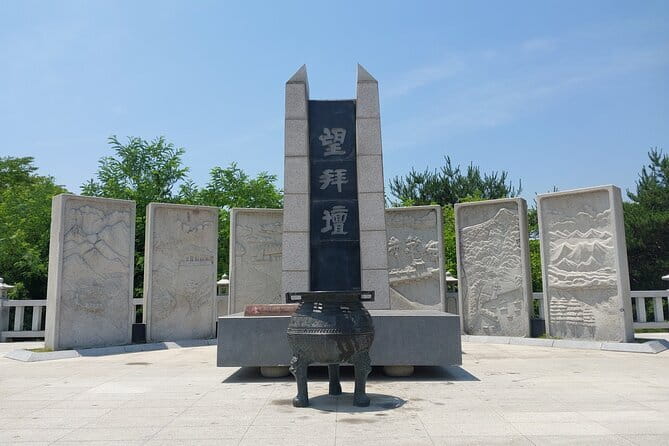
You also see the Mangbaedan Memorial Altar, associated with families who could not return to their ancestral homes in the North. The Steam Locomotive at Jangdan Station provides another direct link to the war. Its damaged body preserves the marks of conflict in a way that a written explanation cannot.
The stop lasts about 90 minutes, giving you time to move among the memorials and hear how the Korean War continues to shape families and public life. This is a good point to ask your guide basic questions, since the later border sites can feel confusing without a clear timeline.
The park is not simply a scenic introduction. It shows how the war remains part of daily memory in South Korea. I would pay attention to the memorial details here rather than treating the stop as a quick break before the DMZ.
The DMZ exhibition hall and its strict rules
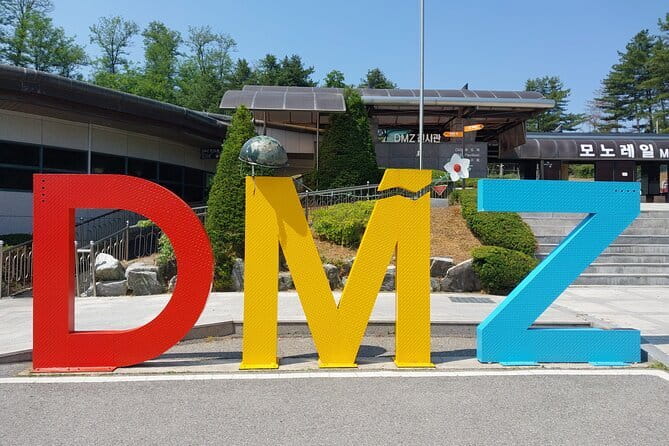
The DMZ stop lasts about 30 minutes and includes a theater presentation about the Korean War, along with an exhibition hall containing records and relics connected with the conflict. This is where you get a general explanation of the Demilitarized Zone and its purpose.
The visit is brief, so do not expect to read every display at length. Your guide’s explanation matters here. Guides such as Bill and Kane have been praised for explaining the conflict in clear, direct terms, while Jae Seo has been noted for carrying visual teaching material, including a large tablet and printed items.
Access to the DMZ is controlled. You must carry your passport on the day of the tour. Without it, you will not be allowed to enter. Bring the actual document, not a photograph or a copy.
You should also expect rules about where you can walk and what you can photograph. One practical warning concerns the northern view: at the viewing area, soldiers monitor photography, and taking pictures facing North Korea is not permitted. The tunnel area also has restrictions on cameras.
These rules are not minor annoyances. They are part of what makes this visit different from an ordinary historic site. Listen closely to instructions, stay with the group, and avoid assuming that every attractive view is available for photographs.
Dora Observatory and the view toward North Korea
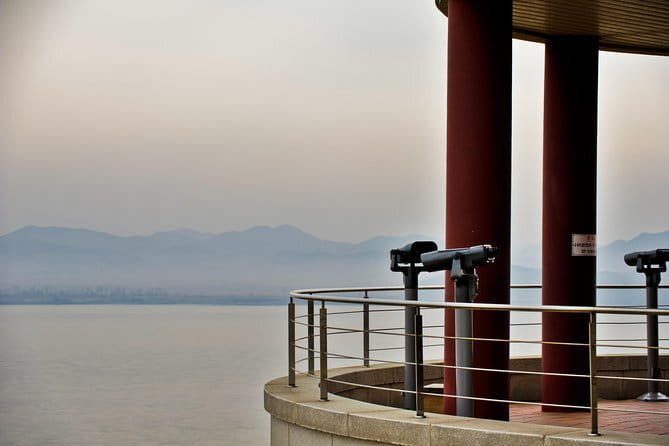
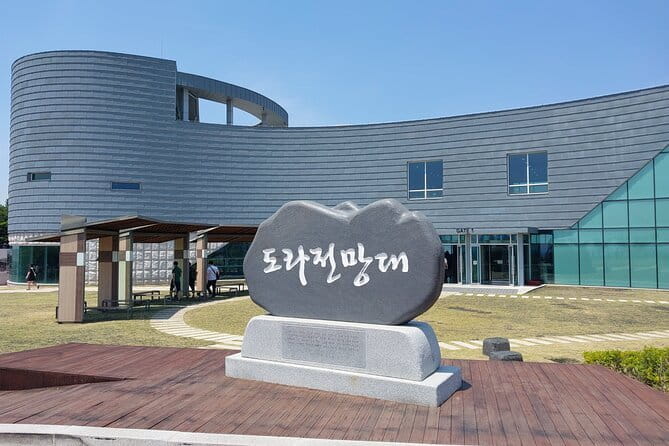
Dora Observatory offers views across the DMZ and toward North Korean territory through binoculars. On a clear day, you may see the northern side, the Propaganda Village, and the Jamming Tower mentioned during the visit.
The view can be hard to interpret without help. From a distance, the border may look calm and open. Your guide helps identify what you are seeing and explains how the area functions. This is one reason I would choose a guided visit over arriving without background.
Weather and military conditions can affect this stop. The tour may use an auditorium presentation instead of the outdoor viewing platform, and that happened for at least one departure because of current conditions. You should see this as a limitation of the location, not a failure of the day. The DMZ is an active security zone, not a museum designed solely around visitor convenience.
Photography is limited, particularly when facing North Korea. Follow the soldiers’ instructions. You may have less freedom than you expect at a lookout, but the short stop still gives you a rare sense of the geography and the distance between the two countries.
More War Memorial visits:
- Seoul: War Memorial of Korea Private Guided Museum Tour
★ 4.9 · 29 reviews - Seoul Morning Tour: Seoul Tower, Namsan Hanok Village, The War Memorial of Korea
★ 4.5 · 22 reviews - Korean War Memorial Private Guided Tour
★ 5.0 · 19 reviews - Exclusive Private DMZ Tour & War Memorial Hall or Suspension Bridge(No Shopping)
★ 5.0 · 17 reviews
Walking the Third Infiltration Tunnel
The Third Tunnel is the most physically memorable part of the tour. It was dug by North Korea into the South and is presented as evidence of a planned invasion route. The visit focuses on the tunnel’s construction, its slope, and the reasons South Korean authorities regard it as an infiltration passage.
The route is steep and narrow. Comfortable clothes and sturdy shoes are strongly recommended. You should have a moderate level of physical fitness, and you need to be ready for a demanding walk rather than a flat museum visit.
A useful detail is that the route does not require stairs down into the tunnel, but the slope is still tiring. Benches are available along the first part, giving you places to rest. The passage becomes cramped enough that anyone uncomfortable in tight spaces should think carefully before booking.
You cannot treat the tunnel as a photo opportunity. Cameras are not allowed inside, and the narrow route makes movement slower. The best approach is to focus on the engineering and the uneasy purpose of the passage.
Several guides receive special praise for handling this part well. Bill is described as walking the tunnel with the group and adjusting his pace for older members. That kind of attention matters here. A guide who keeps everyone together and watches the slower walkers can turn a stressful walk into a manageable one.
The War Memorial of Korea in Seoul
The final major stop is the War Memorial of Korea, with about one hour inside. Admission is included at no extra cost. The museum covers Korea’s long military record as well as the Korean War, so it gives you a wider frame than the border sites alone.
One hour is enough for a guided introduction, but not enough to see everything. If military history interests you, plan a separate visit during your Seoul stay. The museum is large, and the tour’s purpose is to explain the key points rather than let you study every display.
I like having this stop after the DMZ because the day’s earlier sights give the exhibits more force. You have already seen memorials, a divided frontier, a tunnel, and a distant northern view. The museum then helps connect those pieces to the events following World War II and the Korean War.
There is also a good argument for visiting the museum first, if you have the option on another day. A museum introduction would give you more background before the border visit. On this tour, though, the guide supplies a condensed explanation and keeps the group on schedule.
The strongest guides do more than point out objects. They explain the conflict in plain language and answer questions without letting the schedule drift. That is especially useful at a museum where it is easy to spend too long in one gallery.
Guides, group size, and the pace of the day
The guide can shape this experience more than any single exhibit. Bill is repeatedly praised for contact before departure, clear communication through WhatsApp, historical explanations, group photos, and patient help in the tunnel. Kane is noted for careful timing, polite service, thorough explanations, and practical touches such as snacks and water.
Ann Jung is praised for answering questions before the tour, checking on the group during the day, and following up afterward. Jae Seo is described as especially prepared, using a tablet and printed materials to explain the sites. Kevin is praised for being friendly and for presenting the route as a clear introduction to the DMZ and Korean War.
Your assigned guide may be different, but these examples show the service level to expect from a strong departure. The best guides keep the group together, explain military rules before they matter, and adjust their pace when someone struggles in the tunnel.
The advertised maximum is 40 people. That is a fairly large coach group, but some departures have had only seven people and used a smaller van. A small group gives you more room for questions and makes the tunnel easier to manage. You should not book solely expecting a small group, but it can happen.
Timing, transport, lunch, and what to carry
The day begins at 7:00 am near Myeong-dong Station, Subway Line 4, Exit 4. Pickup points are close to hotels in the area, and the tour returns to the Myeong-dong area after the sites are complete.
The air-conditioned vehicle and included parking fees make the long transfer easier. The drive to Imjingak takes about 90 minutes, and the full experience lasts roughly eight to nine hours. An early start is necessary for the border schedule, but it will cut into your morning.
Lunch is not included. Plan to bring money and ask your guide how the day’s timing works, since the supplied details do not promise a particular meal stop. Do not assume you will have a long restaurant break.
Carry your passport, comfortable clothing, and shoes with a good grip. Keep your belongings simple enough to manage during the tunnel walk. Since photography is restricted in important areas, bring your phone for general use but do not count on taking pictures throughout the day.
Cancellations and border uncertainty
The tour can be canceled or delayed because of bad weather or an unexpected military issue. Departure times and the exact DMZ schedule may also change for the same reasons. If the operator cancels because of weather or because the minimum of 10 participants is not reached, you can receive another date or experience, or a full refund.
You can cancel for a full refund up to 24 hours before the start time. Cancellations or changes within 24 hours are not refunded or accepted. Keep this in mind before booking around a tight flight, train connection, or another fixed activity.
The border’s uncertainty is part of the experience, but it does create a real booking risk. If seeing Dora Observatory from the outdoor platform is essential to you, no tour can guarantee that result. You are booking access to a controlled zone, not a fixed attraction with ordinary opening hours.
Is this DMZ and War Memorial tour worth booking?
I would book this tour if you want the DMZ explained rather than simply photographed. The route covers the main accessible sights, includes transportation from central Seoul, and adds the War Memorial, which many short DMZ outings leave out.
It suits first-time visitors to Korea, people interested in the Korean War, and anyone who prefers a guide to handle border procedures. It is also a good fit if you value clear historical explanation and do not mind an early start.
I would look elsewhere if you want a slow museum visit, flexible photography, or an easy walk. The Third Tunnel is steep and narrow, the day follows a firm schedule, lunch costs extra, and military conditions can change the plan.
At $65, the mix of transport, admissions, parking, and guiding is solid value. Book it with your passport ready, your shoes tied, and realistic expectations about the border. The most rewarding part may not be the distant view of North Korea, but the way the whole day shows how an unresolved war still shapes the peninsula.
FAQ
How long does the tour last?
The experience takes approximately eight to nine hours.
Where does the tour begin?
It begins at 7:00 am near Myeong-dong Station, Subway Line 4, Exit 4, in Seoul.
Where does the tour end?
The tour returns to the Myeong-dong area, near the bus drop-off point.
Do I need to bring my passport?
Yes. You must carry your passport on the day of the tour. Without it, you will not be allowed to enter the DMZ.
Is lunch included?
No. Lunch is not included in the tour price.
How difficult is the Third Tunnel?
The Third Tunnel is steep and narrow. Comfortable clothing and shoes are recommended, and visitors should have a moderate level of physical fitness. Benches are available along the first part of the route.
Can I take photographs at the DMZ?
Photography is restricted in some areas. Cameras are not allowed in the tunnels, and you cannot take photographs facing North Korea from the viewing platform.
What happens if bad weather closes the DMZ?
The tour may be delayed, canceled, or changed because of bad weather or an unexpected military issue. If the experience is canceled for poor weather, you will be offered another date or a full refund.
More Museums in Seoul
- Color Pool Museum
★ 4.0 · 22 reviews - SEOUL: Gugak – Korean Traditional Music Museum&Concert Tour
★ 4.7 · 17 reviews - Gyeongju UNESCO Sites Tour by KTX train; The Museum Without walls
★ 4.5 · 11 reviews - Time Travel in Seoul: Gyeongbokgung Palace, Folk Museum & Bukchon
★ 5.0 · 6 reviews
Just added around Seoul
- Incheon Airport Private Transfer between Seoul City★ 4.0 · 4 reviews
- Seoul’s Stars: Open Mic with Local & International Talent★ 4.8 · 4 reviews
- Samaksan Cable Car and Nami Island Day Escape with Railbike★ 4.0 · 4 reviews
- DMZ 2nd Tunnel and Cheorwon Peace Observatory with Admission★ 5.0 · 4 reviews
- Nami & Maple Road & Theatre des Lumieres Day Tour from Seoul★ 4.8 · 4 reviews
- Hire Photographer, Professional Photo Shoot – Seoul★ 5.0 · 4 reviews
- [KoreaByLocal] Authentic Seoul Night Walk and Chicken & Beer★ 5.0 · 4 reviews
- Play Gayageum in Hanbok Cultural Experience in Bukchon★ 5.0 · 4 reviews
DMZ & JSA Tours, compared.
Best DMZ Tour Korea from Seoul (Red Suspension Bridge Optional)
Read our review →
DMZ Tour: 3rd Tunnel, Option(Suspension Bridge, Boat) from Seoul
Read our review →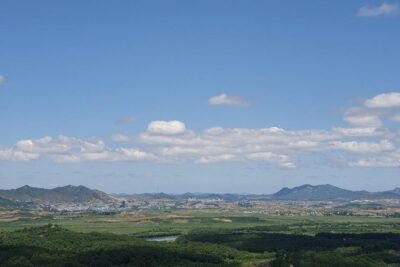
DMZ tour south Korea from Seoul (NK experience hall, defector)
Read our review →
DMZ Insider Tour: 3rd Tunnel, NK Defector Meet & Red Bridge
Read our review →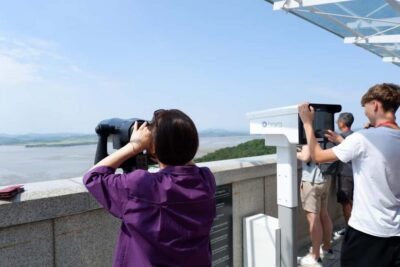
Thrilling Korean DMZ 3rd Tunnel Tour from Seoul + Red Bridge Rush
Read our review →
DMZ Past and Present: Korean Demilitarized Zone Tour from Seoul
Read our review →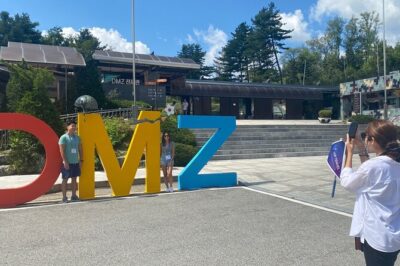
Ultimate Korea DMZ Tour from Seoul (Gondola & Suspension Bridge)
Read our review →Browse the lists this tour appears in