
Reviewed · WALKING TOURS
Seoul moonlight walking tour with local historian
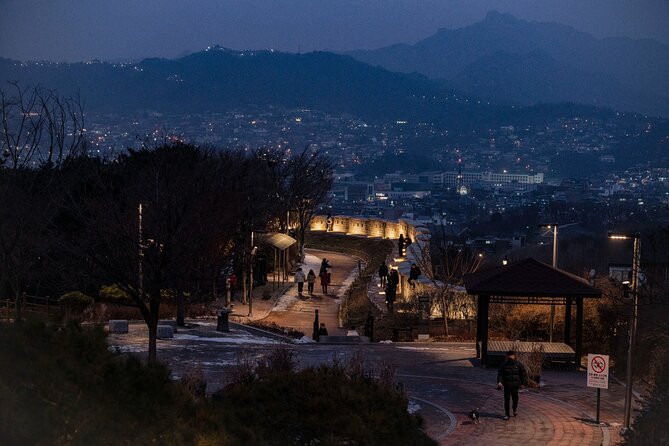
Seoul’s best night view may come after a climb. This two-hour walk from Hyehwa leads through theaters, hillside streets, Ihwa Mural Village, Naksan Park, and the old Seoul City Wall, where the city opens below you in a sweep of lights.
I like two things here: the route connects present-day Korean life with older Seoul, and the guides add local stories you would likely miss on your own. Jessica, Ethan, June, Smin, Leah, and Shin are among the guides praised for humor, clear explanations, and useful answers.
The trade-off is simple: this is a hill walk with stairs. Several people found the climb easy enough, while others warned you to prepare for a fair number of steps. Guide quality and English delivery may also vary by date, so the particular guide you receive can shape the experience.
In This Review
- Key points to know before you book
- Starting among Hyehwa’s theaters and university streets
- What Naksan Park reveals about Seoul
- Ihwa Mural Village, art on a steep social history
- Following the Seoul City Wall into the night
- How the history and modern culture fit together
- Timing, group size, and what to bring
- Which guide style may suit you
- Who should book this evening walk
- Should you book the Seoul moonlight walking tour?
- FAQ
- How long does the Seoul moonlight walking tour last?
- How much does the tour cost?
- Where does the tour start?
- Where does the tour end?
- What places does the tour visit?
- Are admission tickets included?
- Is dinner included?
- How many people can join the tour?
- What happens if the weather is poor?
Key points to know before you book
- Hyehwa begins the story: You start among theaters, university life, cafés, and Marronnier Park rather than at a standard sightseeing landmark.
- The climb has a purpose: Ihwa Village and Naksan Park show how Seoul’s hills, housing, education, and social change fit together.
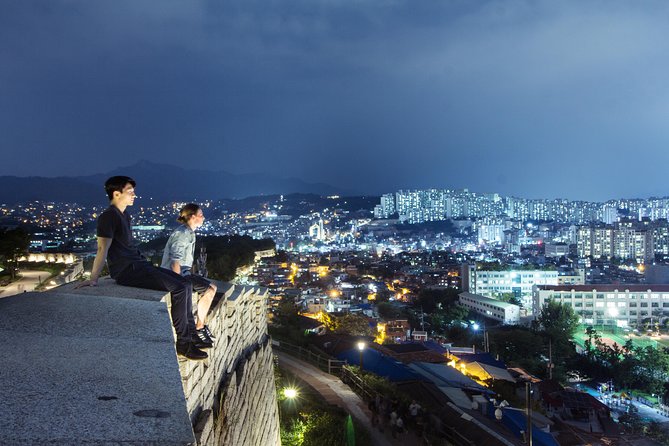
- The city wall is the payoff: The upper section brings wide night views across Seoul, especially around sunset and after dark.
- The guides add modern context: Expect discussion of Korean university culture, social class, daily life, and the way Seoul developed as a capital.
- Budget-friendly pricing: At $31.98 per person, the tour offers a guided route and interpretation without charging separate entry fees.
- Pack for the hill: Wear comfortable shoes, charge your phone, and consider bug spray. Optional food after the walk costs extra.
Starting among Hyehwa’s theaters and university streets
Meet at Hyehwa120 Daehak-ro in Jongno District. The area is near public transportation and gives you a useful introduction before the uphill part begins.
Hyehwa is associated with live theater and shows, and the first part of the walk takes place in a cultural district rather than a formal historic compound. That matters because you begin with Seoul as people use it now: a place for students, performances, food, and evening meetups.
The group then reaches Seoul University Hospital Medical Museum. The stop lasts about 10 minutes and costs nothing. The focus is not a standard medical tour. Instead, the guide uses the site to discuss university culture, including the pressure and status tied to higher education in Korea.
This is one of the more unusual parts of the route. If you have already visited Seoul’s palaces, you may appreciate hearing about the country through its schools and social habits instead of only through royal history. The description of this stop is a little playful, promising unusual details about current university life. Expect conversation and explanation rather than a long museum visit.
Next comes Marronnier Park, with about five minutes set aside for the stop. The park is known for live theater and performances, and it helps explain why Hyehwa feels different from the grand palace districts. The time here is short, but it links the local arts scene to the streets around it.
A few more Seoul trips worth weighing up
- Seoul: Nighttime Hidden Gems Walking Tour
★ 5.0 · 775 reviews - Seoul: Evening Dark History, Folklore & Ghost Story Walking Tour
★ 5.0 · 593 reviews - Seoul: Dark Side of the City and Ghost Stories Walking Tour
★ 4.8 · 484 reviews
What Naksan Park reveals about Seoul
The route continues toward Naksan Park, where the guide explains how Seoul became Korea’s capital and how the city changed as that role developed. The formal stop lasts about 10 minutes, though walking and pauses extend the experience.
Naksan is valuable because it lets you read Seoul from above. You are not only looking at towers and apartment lights. You are also seeing how the old city and the modern city sit together, with steep hills, dense neighborhoods, and major urban growth all compressed into one view.
The guides often use this section to connect geography with politics and social change. That gives the climb more meaning. You are not simply walking to a lookout. You are learning why this part of the city developed as it did.
Guide personality seems to be a major part of the experience. Ethan is described as calm, funny, and open to questions. June is praised for making Korean history and current life easy to follow. Smin and Sumin are noted for friendly, engaging explanations, while Jessica is repeatedly praised for humor and detailed storytelling.
One caution is worth keeping in mind. A less positive assessment found the assigned guide’s English and storytelling weaker than expected. That appears to be an exception among the supplied feedback, but it is still a fair reason to keep expectations flexible. The guide you receive matters on a walking tour built around spoken stories.
Ihwa Mural Village, art on a steep social history
Ihwa Mural Village is the longest named stop, at about 20 minutes. The walk introduces the hillside neighborhood, its murals, and the social conditions that shaped settlements on Seoul’s slopes.
The important point is that the village is not just a photo backdrop. The guide discusses why many hillside communities were associated with people with fewer resources and how that history affects the way you see the area. This adds a needed layer to the painted stairways and decorated walls.
You might find the setting visually cheerful, but the explanation asks you to look past the artwork. The route connects housing, income, redevelopment, and the unequal experience of life in a major city. That is a useful counterpoint to Seoul’s polished shopping streets and modern towers.
The stop itself is fairly brief. If you want a long photography session at every mural, two hours will feel tight. If you prefer a guided introduction that puts the art into context, the timing keeps the evening moving.
You should also remember that this is a residential area. The tour description emphasizes the local setting and lesser-known streets, but you are still walking through a neighborhood rather than a purpose-built attraction. Follow the guide’s lead, keep your voice down, and avoid treating private doorways or homes as photo props.
Following the Seoul City Wall into the night
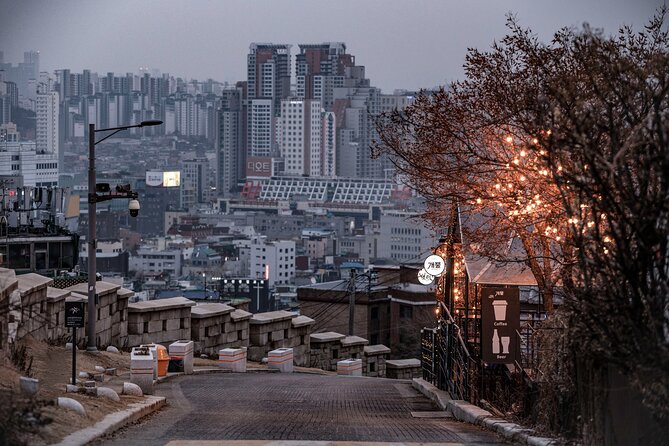
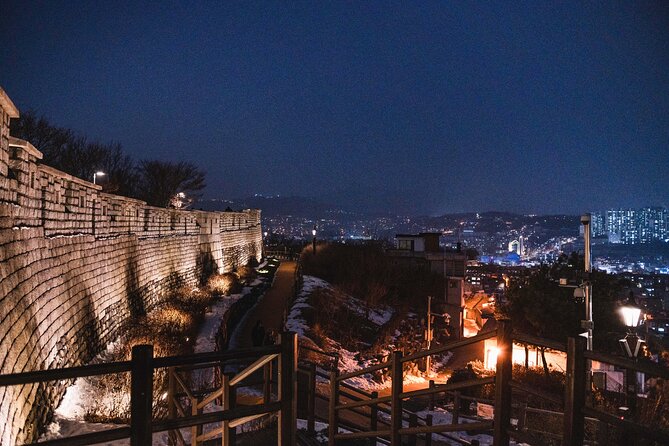
The Seoul City Wall is the scenic high point. The walk along this historic monument takes about 20 minutes and brings the strongest city views of the evening.
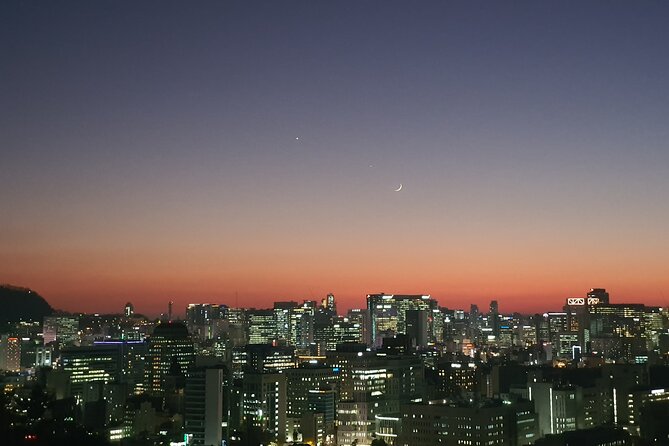
As the path rises, more of Seoul’s lights come into view. The experience works best around sunset, when you may get both the last daylight and the glow of the city after dark. Exact conditions depend on the start time and weather, but the route is designed around the transition into evening.
The wall also gives the walk a strong sense of place. Seoul’s history is not sealed away in a museum. It appears in the stonework, the hill paths, and the way the old boundary meets a huge modern capital.
This is where your phone earns its keep. Bring it charged for views and photographs. One practical suggestion is to carry bug spray, especially in warmer weather. You do not need special equipment, but you do need shoes that handle slopes and stairs comfortably.
The climb is not described as an extreme hike, and several comments call it manageable. Still, the route goes uphill and later back down stairs. If you have knee trouble, dislike uneven paths, or want a flat evening stroll, this may not be your best Seoul activity.
A completely different kind of day, same trip:
- Best DMZ Tour Korea from Seoul (Red Suspension Bridge Optional)
★ 5.0 · 41,422 reviews - DMZ Tour: 3rd Tunnel, Option(Suspension Bridge, Boat) from Seoul
★ 5.0 · 21,373 reviews - DMZ tour south Korea from Seoul (NK experience hall, defector)
★ 5.0 · 20,599 reviews - DMZ Insider Tour: 3rd Tunnel, NK Defector Meet & Red Bridge
★ 4.9 · 15,214 reviews
How the history and modern culture fit together
The strongest feature is the range of topics packed into a short walk. You hear about the capital’s location, university entrance culture, social class, neighborhood change, arts districts, and daily life in Korea.
That mixture makes the tour useful early in a Seoul visit. You get terms and ideas that can help you understand the rest of the city. A solo visitor may also find the shared walk an easy way to meet people, since the group is capped at 20 and the route includes natural pauses for conversation.
I especially like that the tour does not depend on admission tickets. Every named stop is free, and the value comes from the guide’s route planning and interpretation. You are paying $31.98 for about two hours, which is reasonable if you want local explanation and a night view without arranging the route yourself.
The value is less clear if you already know Naksan Park and Ihwa Village well. You can walk these areas independently, and the landmarks do not require a ticket. In that case, the main reason to pay is the social and historical context, not access to a restricted site.
The provider has received a five-star rating with 940 reviews and a 100 percent recommendation figure in the supplied information. The experience is also identified with 2024 awards from Tripadvisor and Klook. Those figures suggest steady demand, but they do not remove the practical questions about hills, weather, group pace, and the guide assigned on your date.
Timing, group size, and what to bring
The advertised duration is about two hours. The listed stop times add up to roughly 65 minutes, leaving the rest for walking, uphill sections, photographs, and the transitions between places.
The group can include up to 20 people. That is large enough for a social feel but small enough for a guide to answer questions more easily than on a large coach excursion. Pace may still vary, especially on stairs, so do not plan a tightly timed dinner reservation immediately afterward.
The activity starts and ends at the same Hyehwa meeting point. That makes planning easier, particularly if you are using public transportation. You will not need to arrange a separate ride from a distant viewpoint after the walk.
Bring:
- Comfortable walking shoes
- A fully charged phone
- Bug spray, especially in warm weather
- Water, if you normally need it during uphill walks
- A light layer if the evening is cooler than expected
No special supplies are required. Dinner is not included, but an optional food session takes place after the tour for an additional fee. You can treat that as a useful add-on or simply finish at the meeting point and make your own plans.
The tour requires good weather. If poor weather cancels it, you are offered another date or a full refund. You can cancel for a full refund up to 24 hours before the start time. Changes or cancellations made inside that window are not accepted for a refund.
Which guide style may suit you
The supplied feedback gives a clear picture of what the best guide-led version offers. Jessica is praised for humor and detailed explanations. Ethan is described as entertaining, patient, and good with recommendations. June receives strong praise for turning history and current Korean life into an enjoyable conversation.
Smin is praised for strong English, kindness, and clear information. Leah is described as guiding the group in a relaxed, friendly way. Sumin is noted for explaining education and university entrance culture, while Shin is praised for an informative presentation.
These details point to an experience that depends heavily on storytelling. The stops alone are pleasant, but the guide supplies the meaning. If you enjoy asking questions about culture and society, you are likely to get more from the walk than someone interested only in taking photographs.
At the same time, you should not assume every guide will have the same English fluency or delivery. One poor assessment specifically raised that concern. I would still consider the overall feedback strongly positive, but I would book this for the route and subject matter, not on the promise of one particular guide unless the provider confirms who is leading your date.
Who should book this evening walk
I would choose this tour if you want Seoul views with more substance than a lookout platform. It suits first-time visitors, solo visitors, and anyone curious about how education, housing, class, culture, and history shape everyday Korea.
It is also a good fit if you have already seen the major palaces and want a different side of Jongno. Hyehwa’s theater district, Ihwa’s hillside streets, and the wall paths offer a less formal look at the city.
I would skip it if you want a flat route, a quiet nature walk, or a long stop at each attraction. The walk includes hills and stairs, and the two-hour schedule favors variety over a slow examination of every mural or monument.
Should you book the Seoul moonlight walking tour?
Book it if you value local explanation, changing city views, and a route you might not plan alone. At $31.98, it is a fair buy for a two-hour introduction to Hyehwa, Ihwa, Naksan Park, and the Seoul City Wall, especially when you consider that the guide adds social and historical context rather than simply pointing out landmarks.
Go prepared for stairs, charge your phone, and leave room for the optional food stop afterward. If the weather looks poor, keep your schedule flexible. For an evening that combines Korean culture, hillside neighborhoods, and a strong view of Seoul’s lights, this is one of the more useful short walks in the city.
FAQ
How long does the Seoul moonlight walking tour last?
The tour lasts approximately two hours, including the walking time and stops along the route.
How much does the tour cost?
The listed price is $31.98 per person.
Where does the tour start?
The meeting point is Hyehwa120 Daehak-ro in Jongno District, Seoul, near public transportation.
Where does the tour end?
The activity ends back at the Hyehwa meeting point.
What places does the tour visit?
The route includes Seoul University Hospital Medical Museum, Marronnier Park, Naksan Park, Ihwa Mural Village, and the Seoul City Wall.
Are admission tickets included?
There are no separate admission charges for the listed stops. The tour also states that no special supplies are needed.
Is dinner included?
No. An optional food session takes place after the walk, but its fee is not included.
How many people can join the tour?
The maximum group size is 20 people.
What happens if the weather is poor?
The experience requires good weather. If it is canceled because of poor weather, you are offered a different date or a full refund.
Just added around Seoul
- Incheon Airport Private Transfer between Seoul City★ 4.0 · 4 reviews
- Seoul’s Stars: Open Mic with Local & International Talent★ 4.8 · 4 reviews
- Samaksan Cable Car and Nami Island Day Escape with Railbike★ 4.0 · 4 reviews
- DMZ 2nd Tunnel and Cheorwon Peace Observatory with Admission★ 5.0 · 4 reviews
- Hire Photographer, Professional Photo Shoot – Seoul★ 5.0 · 4 reviews
- [KoreaByLocal] Authentic Seoul Night Walk and Chicken & Beer★ 5.0 · 4 reviews
- Nami & Maple Road & Theatre des Lumieres Day Tour from Seoul★ 4.8 · 4 reviews
- Play Gayageum in Hanbok Cultural Experience in Bukchon★ 5.0 · 4 reviews
Walking Tours, compared.
Evening Dark History, Folklore & Ghost Story Walking Tour
Read our review →
Dark Side of the City and Ghost Stories Walking Tour
Read our review →
Gangnam Walking Tour on Youth and Society in Seoul Korea
Read our review →
Gyeongbok Palace and Bukchon Hanok Walking Tour
Read our review →
Best Walking Tour to Gyeongbok Palace Bukchon Hanok Village
Read our review →
Highlights & Hidden Gems With Locals: Best of Seoul Private Walking Tour
Read our review →
Street photoshoot and Seoul Hidden gem History Walking Tour
Read our review →Browse the lists this tour appears in