
Reviewed · SUWON HWASEONG FORTRESS
Korean Folk Village and Suwon Hwaseong Fortress Day Tour(EG Tour)
The best part of this day is the contrast: you begin among reconstructed Joseon-era homes and live cultural shows, then walk the walls of a real 18th-century fortress before ending among food stalls in Suwon. It gives you three very different views of Korean culture in one outing.
I like the live horseback martial arts and traditional performances at the folk village, and I like having round-trip transport from Seoul for a long day outside the city. Guides including Joon, Cecilia, Gina, Laura, and Stella are often praised for clear explanations and personal stories.
The trade-off is time. The folk village is large, the fortress deserves more than a quick look, and the market stop may feel optional if you have already visited Seoul markets. Traffic, heat, rain, and late departures can also affect the pace.
In This Review
- Key points before you book
- What this Seoul day trip actually covers
- Korean Folk Village: Joseon life with a stage-show side
- Suwon Hwaseong Fortress: the day’s most impressive walk
- Suwon Nammun Market: a casual finish with room to choose
- How the schedule feels in real life
- What the guides add to the experience
- Is $69.52 good value?
- Who should book this tour?
- Final call: a useful first look at Suwon
- FAQ
- How long does the Korean Folk Village and Suwon Hwaseong Fortress tour last?
- What is included in the tour price?
- Is the Korean Folk Village a real residential village?
- What performances can I see at the folk village?
- How much time is spent at Suwon Hwaseong Fortress?
- Can I cancel for a full refund?
Key points before you book
- Three distinct stops in one day: Visit the Korean Folk Village, Suwon Hwaseong Fortress, and Suwon Nammun Market.
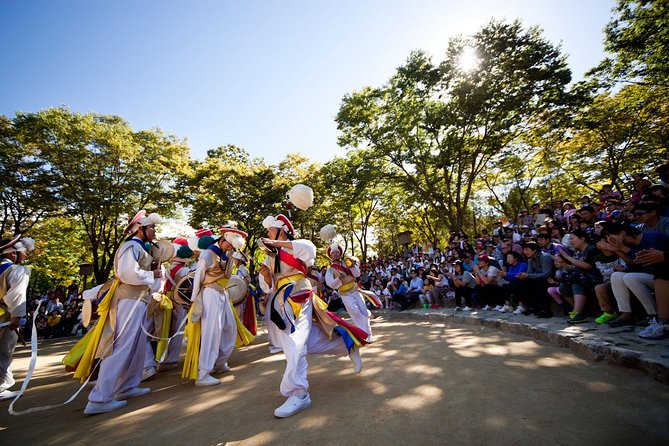
- Live culture, not just buildings: See traditional music, dance, horseback martial arts, and a traditional wedding ceremony when scheduled.
- A reconstructed folk village: It presents Joseon-period life well, but it is a tourist attraction with shops and restaurants, not a working village.
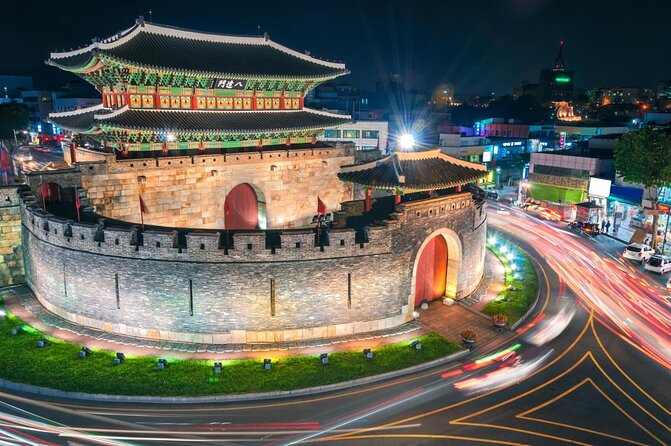
- A UNESCO-listed fortress: Walk part of Suwon Hwaseong’s walls and see gates and watchtowers built under King Jeongjo.
- Food at your own pace: The market gives you free time to try items such as hotteok, fishcake, sausage, or sweet rice drink.
- A long, active day: The tour lasts about 10 to 11 hours, with roughly 5.5 hours allocated to the three stops and the rest spent getting around.
What this Seoul day trip actually covers
This is a full-day excursion from Seoul, priced at $69.52 per person, with transportation, admission fees, and English or Chinese-speaking staff included. The published stop times add up to about five and a half hours, but the complete outing takes roughly 10 to 11 hours once city pickup, road time, and traffic are included.
That price makes sense if you want convenience. You avoid arranging separate transport to Yongin and Suwon, buying entrance tickets, and working out how to connect three places in one day. Meals and personal spending are extra, so you should still budget for lunch or market snacks.
The group can include up to 43 people. That is not a small private outing, and you should expect some waiting at meeting points, departures, and crowded areas. The benefit is a relatively affordable way to cover a wide area, with a guide helping you understand what you are seeing.
The tour has a current rating of 4.7 from 80 ratings, with 94 percent recommending it. The strongest praise goes to the guides, transport, cultural performances, and the variety of the day. The most common reservations concern limited time, the touristy nature of the folk village, and the brief fortress visit.
More Korean Folk Village visits:
- Seoul: Suwon Hwaseong Fortress & Korean Folk Village Tour
★ 4.7 · 214 reviews - Seoul: Suwon Hwaseong, Folk Village, & Starfield Library
★ 4.8 · 55 reviews - Traditional Korean folk village Afternoon tour
★ 5.0 · 52 reviews
Korean Folk Village: Joseon life with a stage-show side
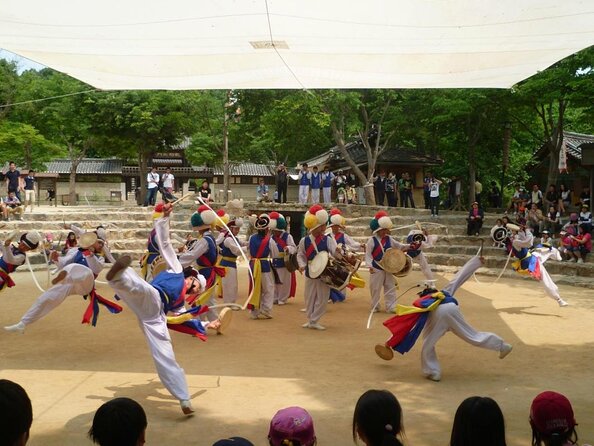
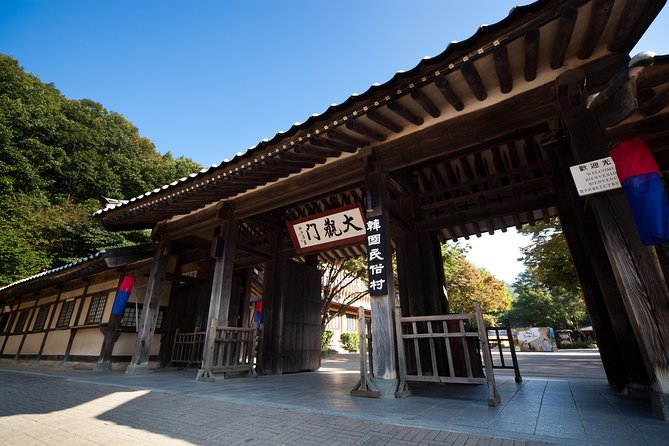
The first stop lasts about three hours and includes admission. Korean Folk Village introduces customs and daily life from the late Joseon period through traditional houses, cultural demonstrations, seasonal practices, shaman beliefs, and performances.
The setting is designed for visitors, so it is important to set your expectations correctly. You are not entering an ordinary village where families live today. You are visiting a reconstructed historical park with houses, displays, shops, restaurants, and scheduled entertainment.
That does not make it pointless. The village gives you a clear visual introduction to how social classes, homes, crafts, clothing, and rural work were presented in the Joseon era. If Korean period dramas have made you curious about royal officials, farmers, family customs, or old-style buildings, this is a useful place to connect those images with real explanations.
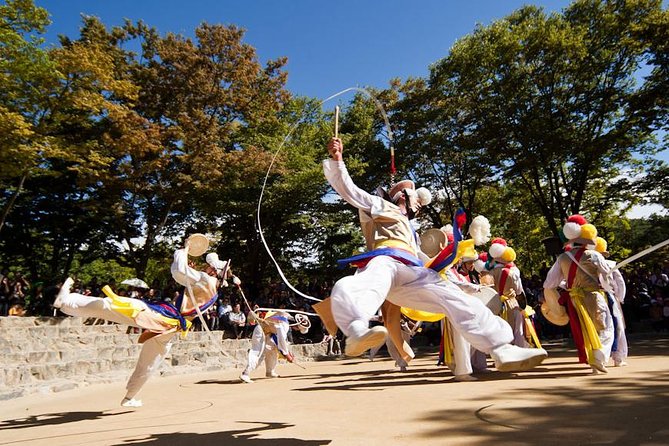
The live performances are a major reason to come. Depending on the schedule, you may see traditional music and dance, a wedding ceremony, horseback martial arts, or other demonstrations. One particularly well-liked addition is a performance featuring traditional music and hanbok dress, sometimes offered through the cultural center.
The horseback martial arts show adds action to what could otherwise be a quiet architectural visit. Families and children often respond well to the movement and spectacle, though the tour is not necessarily ideal for very young children who struggle with long periods of walking, sitting, or listening through audio equipment.
You will have some independent time, but do not expect unlimited freedom. The village is larger than many first-time visitors expect, and three hours can pass quickly if you stop for photos, watch a show, browse the buildings, and pause for food.
One useful feature is the guide’s ability to explain the social and political background behind what you see. Cecilia has been praised for explaining Joseon kings in a way that connects with familiar Korean dramas. Joon is also noted for clear English and patient explanations, while Gina, Laura, Julie, Sally, and Stella have each been praised for keeping groups engaged and comfortable.
Some guides provide headphones or audio devices so you can hear while standing with a group. This matters during performances and in busy areas, though younger children may find the equipment bothersome.
Suwon Hwaseong Fortress: the day’s most impressive walk
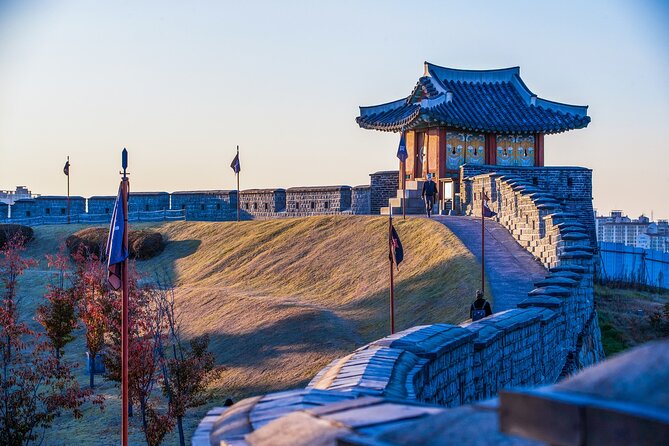
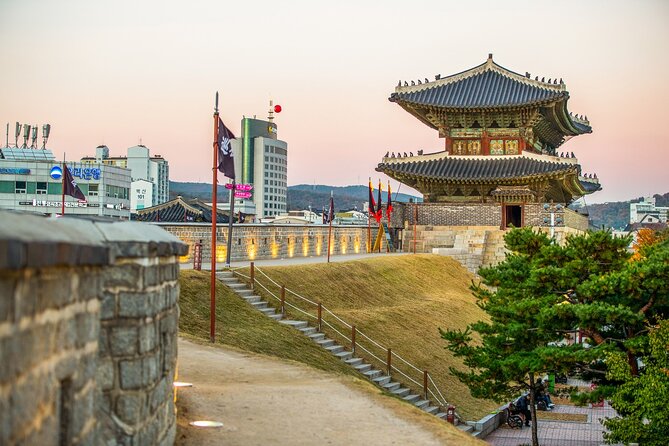
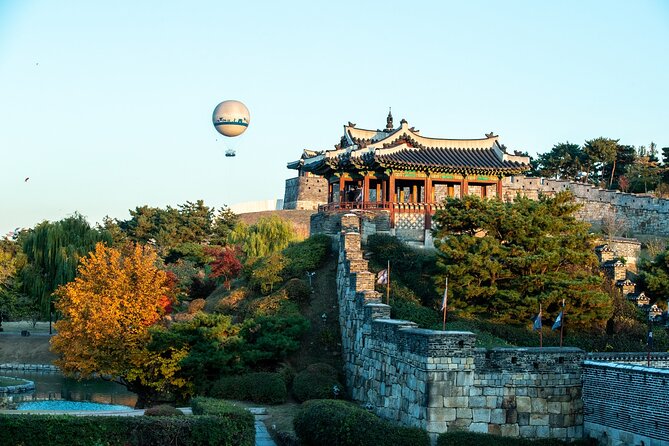
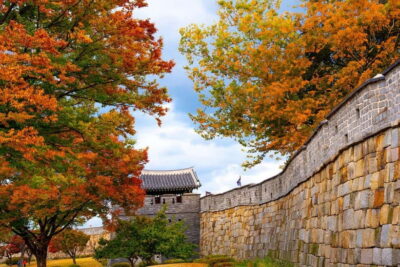
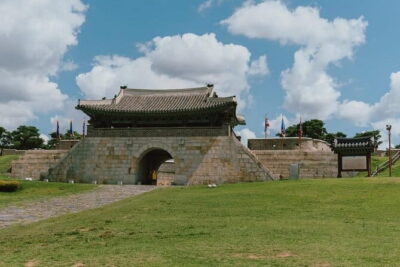
After the folk village, the tour continues to Suwon Hwaseong Fortress, a UNESCO World Heritage site in Suwon. The fortress was built in the late 18th century under King Jeongjo as a defensive structure and palace complex.
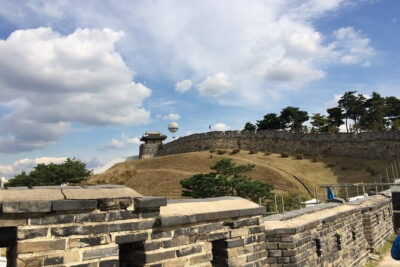
The walls extend for almost six kilometers, but this tour does not attempt to walk the entire circuit. Your scheduled time is about one hour and 30 minutes, enough to see important sections, gates, watchtowers, and parts of the wall, but not enough for a complete exploration.
I find the fortress more substantial than a simple photo stop. The scale becomes clear as you walk beside the walls and look toward the gates and elevated structures. The site also gives your guide room to explain King Jeongjo’s plans, the fortress’s military role, and the way the complex connected defense with royal power.
The amount of walking is manageable for most people who can participate in ordinary sightseeing, but the day can feel demanding in hot weather or rain. Laura and Cecilia have both been praised for adjusting their pace and making rest a priority during extreme heat. In wet weather, the stone paths and open sections are less comfortable, and some scheduled features may be cancelled.
The main limitation is the short visit. If you are especially interested in military architecture, city walls, or Korean royal history, you may wish for a longer stay. One hour and 30 minutes lets you understand the site and see a striking section, but it only covers part of the fortress.
The experience can also depend on the guide’s storytelling. Jonathan Kim has been praised for adding personal anecdotes to the historical explanation, while Stella has been credited with giving detailed context at both the folk village and fortress. A good guide helps you see more than stone walls. Without that context, the visit could feel like a brisk walk around an attractive old structure.
Suwon Nammun Market: a casual finish with room to choose
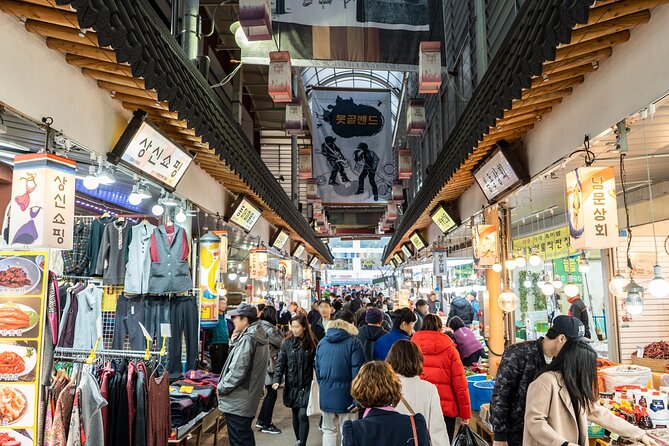
The final stop is Suwon Nammun Market, where you have about an hour of free time and no additional admission charge. The market has roots reaching back to the Joseon period and is one of Suwon’s older traditional market areas.
This is the least essential stop for some people and a welcome finish for others. If you enjoy trying small portions of local food, an hour gives you a chance to sample something without committing to a formal meal. Hotteok, spicy fishcake, sausage, and sweet rice drink are among the items that have been enjoyed during the stop.
The market also helps balance the historical sites. After several hours of guided interpretation, you can simply look around, eat, and choose your own pace. Guides such as Jonathan have helped with food suggestions, which is useful if you are unsure what to order or how much to buy.
I would not book this tour solely for Nammun Market. Seoul has many markets, and you may find this stop less exciting if you have already visited several. Still, the market works well as a flexible ending, especially if your group cannot agree on one final activity.
Some outings have included nearby Chicken Street when weather affected a planned fortress light show. Treat any special evening feature as weather-dependent rather than guaranteed.
More Suwon and Hwaseong Fortress trips:
- Beyond Seoul: Starfield Library, Hwaseong Fortress & Cave Quest
★ 5.0 · 177 reviews - From Seoul: Suwon Hwaseong Fortress Tour
★ 5.0 · 108 reviews - Suwon Hwaseong+Gwangmyeong Cave+Starfield Library from Seoul
★ 5.0 · 104 reviews - Suwon Hwaseong, Gwangmyeong Cave, & Starfield Library Trip
★ 4.4 · 87 reviews
How the schedule feels in real life
The tour is advertised as a 10 to 11-hour experience, though the sightseeing portion is described as a 7 to 8-hour day away from Seoul. In practical terms, you should prepare for a long outing with road time, guided walks, performances, and free periods.
The order is straightforward:
- About three hours at Korean Folk Village
- About one hour and 30 minutes at Suwon Hwaseong Fortress
- About one hour at Suwon Nammun Market
- Round-trip transportation between Seoul and the sites
Traffic can change the timing. One practical complaint is that late arrivals at pickup points caused the group to miss part of the first performance and reach the village behind schedule. Arrive at least 15 minutes early, even if the meeting instructions do not make that strongly clear.
The tour can also feel rushed because the folk village is so extensive. If you want to photograph every house, attend every performance, and explore every corner independently, you may find the guided schedule restrictive. The benefit is that you see the major highlights without having to plan the route yourself.
Comfort depends heavily on the weather. Several people enjoyed the outing despite heavy rain, while others found the conditions made the day difficult. Extreme heat also requires care. Wear practical shoes, carry water, and check the forecast before you go. The itinerary can change because of traffic or weather.
What the guides add to the experience
The guide is the part of this tour that can turn a busy day into a useful one. The strongest guide feedback centers on clear English, patience, historical explanation, personal anecdotes, and attention to group comfort.
Joon is praised for being informative and patient. Cecilia is noted for making Joseon history easier to follow and for helping people stay comfortable during hot weather. Gina receives praise for creating a friendly atmosphere and explaining the village and fortress clearly.
Laura has been commended for guiding in extreme heat and heavy rain. Stella is described as engaging and personal, while Jonathan Kim is praised for keeping the group moving through a tight schedule and adding memorable stories. Julie and Sally are also noted for making the day accessible and pleasant.
Guide assignments can change, so you should not book expecting one specific person unless the company confirms that directly. Still, the pattern is clear: the experience depends less on luxury and more on having someone who can make sense of the places.
Headphones may be used for group commentary. That helps you hear in open courtyards and crowded spaces, but you will need to stay aware of meeting times and keep up with the group.
Is $69.52 good value?
At $69.52, this is fair value for a full day if you want transport and admission handled for you. The cost covers round-trip transportation, entrance fees, and English or Chinese-speaking staff. You still pay for meals, snacks, insurance, and personal purchases.
The value is strongest for first-time visitors who want to connect Seoul with Suwon and the folk village without building a complicated independent route. It is also practical for families or friend groups with different interests. One person can focus on architecture, another on performances, and another on food.
The value is weaker if you prefer slow travel. You may feel constrained by the group schedule, especially at the fortress. If you already know Suwon well or have visited several Korean markets, the final stop may not add much.
The included performances help justify the price, as does the guide’s historical context. Admission to both major sites is already included, so you do not face surprise entrance charges during the day.
Who should book this tour?
I would recommend it to you if you want a broad introduction to traditional Korean culture, especially on a first visit to Seoul. It is a good fit for adults, older children, history fans, Korean drama viewers, and anyone who prefers a guide to explain the background rather than reading signs alone.
It also suits a group with mixed interests. The folk village offers buildings and shows, the fortress offers views and walking, and the market offers food and free time.
I would think twice if you want a quiet, flexible day or if you already plan to visit many traditional villages and markets. The folk village is reconstructed and commercial in parts, not an untouched historic community. The fortress is impressive, but the scheduled 90 minutes only gives you a taste.
Book at least a day with a reasonable weather forecast if possible. Rain does not make the trip impossible, but it can affect performances and fortress activities. For the best chance of seeing the first show and getting the full schedule, arrive early at the meeting point.
Final call: a useful first look at Suwon
Book this tour if you want variety, transport, and historical guidance more than complete freedom. The folk village supplies the performances and Joseon-era setting, Hwaseong provides the strongest sense of place, and Nammun Market gives you an easy chance to eat and wander.
Skip it if you want to spend a whole day at the fortress or prefer living neighborhoods over a reconstructed cultural park. For most first-time visitors, though, the combination offers a solid return on your time and money. The day is long, but it brings together architecture, performance, royal history, and local food in a way that is hard to arrange as neatly on your own.
Cancellation is free up to 24 hours before the start time for a full refund. Changes or cancellations made less than 24 hours ahead are not accepted for a refund.
FAQ
How long does the Korean Folk Village and Suwon Hwaseong Fortress tour last?
The complete tour takes approximately 10 to 11 hours. The scheduled visits include about three hours at Korean Folk Village, one hour and 30 minutes at Suwon Hwaseong Fortress, and one hour at Suwon Nammun Market.
What is included in the tour price?
The price includes round-trip transportation, entrance fees, and English or Chinese-speaking staff. Meals, travel insurance, and personal expenses are not included.
Is the Korean Folk Village a real residential village?
No. It is a reconstructed cultural park presenting traditional life from the late Joseon period. It includes traditional buildings, performances, shops, and restaurants.
What performances can I see at the folk village?
The program can include traditional music and dance, horseback martial arts, and a traditional wedding ceremony. Specific performances may depend on the schedule, weather, and operating conditions.
How much time is spent at Suwon Hwaseong Fortress?
The scheduled visit lasts about one hour and 30 minutes. You can walk along part of the fortress walls and see gates and watchtowers, but the time is not long enough to explore the full almost six-kilometer wall circuit.
Can I cancel for a full refund?
Yes. You can cancel at least 24 hours before the experience start time for a full refund. Cancellations or changes made less than 24 hours before the start time are not accepted for a refund.
Just added around Seoul
- Incheon Airport Private Transfer between Seoul City★ 4.0 · 4 reviews
- Seoul’s Stars: Open Mic with Local & International Talent★ 4.8 · 4 reviews
- Samaksan Cable Car and Nami Island Day Escape with Railbike★ 4.0 · 4 reviews
- DMZ 2nd Tunnel and Cheorwon Peace Observatory with Admission★ 5.0 · 4 reviews
- [KoreaByLocal] Authentic Seoul Night Walk and Chicken & Beer★ 5.0 · 4 reviews
- Nami & Maple Road & Theatre des Lumieres Day Tour from Seoul★ 4.8 · 4 reviews
- Hire Photographer, Professional Photo Shoot – Seoul★ 5.0 · 4 reviews
- Play Gayageum in Hanbok Cultural Experience in Bukchon★ 5.0 · 4 reviews
Suwon Hwaseong Fortress, compared.
Suwon Hwaseong Fortress & Korean Folk Village Tour
Read our review →
Beyond Seoul: Starfield Library, Hwaseong Fortress & Cave Quest
Read our review →
Suwon Hwaseong+Gwangmyeong Cave+Starfield Library from Seoul
Read our review →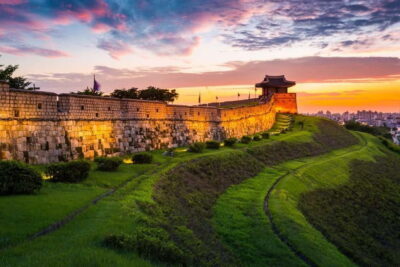
Suwon Hwaseong, Gwangmyeong Cave, & Starfield Library Trip
Read our review →
Day Tour of Suwon Hwaseong Fortress Starfield Waujeongsa Temple
Read our review →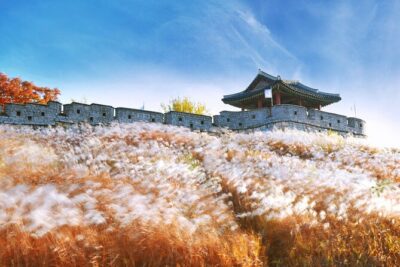
Day Trip to UNESCO: Suwon Fortress Adventure from Seoul
Read our review →Browse the lists this tour appears in